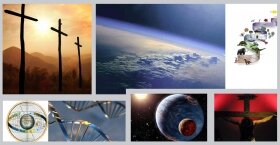
| | cosmology |
| | Cosmology, from the Greek: κοσμολογία (cosmologia, κόσμος (cosmos) world + λογια (logia) discourse) is the study of the Universe in its totality, and by extension, humanity's place in it. Though the word cosmology is recent (first used in 1730 in Christian Wolff's Cosmologia Generalis), the study of the Universe has a long history involving science, philosophy, esotericism, and religion (see cosmological argument, kalam cosmological argument).DisciplinesIn recent times, physics and astrophysics have come to play a central role in shaping what is now known as physical cosmology, i.e. the understanding of the Universe through scientific observation, experiments, and theorizing. This discipline, which focuses on the Universe as it exists on the largest scales and at the earliest times, begins by arguing for the big bang, a sort of cosmic explosion from which the Universe itself is said to have erupted ~13.7 ± 0.2 billion (109) years ago. After its violent beginnings and until its very end, scientists then propose that the entire history of the Universe has been an orderly progression governed by physical laws. (see also: Kalam cosmological argument) In between the doctrines of religion and science, stands the philosophical perspective of metaphysical cosmology. This ancient field of study seeks to draw logical conclusions about the nature of the Universe, man, god and/or their connections based on the extension of some set of presumed facts borrowed from religion and/or observation.Cosmology is often an important aspect of the origin beliefs of religions and mythologies that seek to explain the existence and nature of the reality. In some cases, views about the creation (cosmogony) and destruction (eschatology) of the Universe play a central role in shaping a framework of religious cosmology for understanding humanity's role in the Universe.A more contemporary distinction between religion and philosophy, esoteric cosmology is distinguished from religion in its less tradition-bound construction and reliance on modern "intellectual understanding" rather than faith, and from philosophy in its emphasis on spirituality as a formative concept.Physical cosmologyPhysical cosmology is the branch of physics and astrophysics that deals with the study of the physical origins of the Universe and the nature of the Universe on its very largest scales. In its earliest form it was what is now known as celestial mechanics, the study of the heavens. The Greek philosophers Aristarchus of Samos, Aristotle and Ptolemy proposed different cosmological theories. In particular, the geocentric Ptolemaic system was the accepted theory to explain the motion of the heavens until Nicolaus Copernicus, and subsequently Tycho Brahe, Johannes Kepler and Galileo Galilei proposed a heliocentric system in the 16th century. This is known as one of the most famous examples of epistemological rupture in physical cosmology.With Isaac Newton and the 1687 publication of Principia Mathematica, the problem of the motion of the heavens was finally solved. Newton provided a physical mechanism for Johannes Kepler's laws and his law of universal gravitation allowed the anomalies in previous systems, caused by gravitational interaction between the planets, to be resolved. A fundamental difference between Newton's cosmology and those preceding it was the Copernican principle that the bodies on earth obey the same physical laws as all the celestial bodies. This was a crucial philosophical advance in physical cosmology.Modern scientific cosmology is usually considered to have begun in 1917 with Albert Einstein's publication of his final modification of general relativity in the paper "Cosmological Considerations of the General Theory of Relativity," (although this paper was not widely available outside of Germany until end of World War I). General relativity prompted cosmogonists such as Willem de Sitter, Karl Schwarzschild and Arthur Eddington to explore the astronomical consequences of the theory, which enhanced the growing ability of astronomers to study very distant objects. Prior to this (and for some time afterwards), physicists assumed that the Universe was static and unchanging; subsequent modeling of the universe explored the possibility that the cosmological constant introduced by Einstein in that paper may result in an expanding universe, depending on its value. Thus the big bang theory was proposed by the Belgian priest Georges Lemaître in 1927 and rapidly confirmed by Edwin Hubble's discovery of the red shift in 1929 and later by the discovery of the cosmic microwave background radiation by Arno Penzias and Robert Woodrow Wilson in 1964.Recent observations made by the COBE and WMAP satellites observing this background radiation have effectively, in many scientists eyes, transformed cosmology from a highly speculative science into a predictive science, as these observations matched predictions made by a theory called Cosmic inflation, which is a modification of the standard big bang theory (see also Kalam cosmological argument). This has led many to refer to modern times as the "Golden age of cosmology."Metaphysical cosmologyIn philosophy and metaphysics, cosmology deals with the world as the totality of space, time and all phenomena. Historically, it has had quite a broad scope, and in many cases was founded in religion. The ancient Greeks did not draw a distinction between this use and their model for the cosmos. However, in modern use it addresses questions about the Universe which are beyond the scope of science. It is distinguished from religious cosmology in that it approaches these questions using philosophical methods (e.g. dialectics). Modern metaphysical cosmology tries to address questions such as: - What is the origin of the Universe? What is its first cause?
- Is its existence necessary?
- What are the ultimate material components of the Universe?
- What is the ultimate reason for the existence of the Universe?
- Does the cosmos have a purpose?
Religious cosmologyMany world religions have origins beliefs that explain the beginnings of the Universe and life. Often these are derived from scriptural teachings and held to be part of the faith's dogma, but in some cases these are also extended through the use of philosophical and metaphysical arguments.In some origin beliefs, the universe was created by a direct act of a god or gods who are also responsible for the creation of humanity (see creationism). In many cases, religious cosmologies also foretell the end of the Universe, either through another divine act or as part of the original design.Both Christianity and Judaism rely on the Genesis narrative as a scriptural account of cosmology. See also Biblical cosmology and Tzimtzum. Islam relies on understanding from the Qu'ran as its major source for explaining cosmology. Certain adherents of Buddhism, Hinduism and Jainism believe that the Universe passes through endless cycles of creation and destruction, each cycle lasting for trillions of years (e.g. 331 trillion years, or the life-span of Brahma, according to Hinduism), and each cycle with sub-cycles of local creation and destruction (e.g. 4.32 billion years, or a day of Brahma, according to Hinduism). The Vedic (Hindu) view of the world sees one true divine principle self-projecting as the divine word, 'birthing' the cosmos that we know from the monistic Hiranyagarbha or Golden Womb. Many religions accept the findings of physical cosmology, in particular the big bang, and some, such as the Roman Catholic Church, have embraced it as suggesting a philosophical first cause. Others have tried to use the methodology of science to advocate for their own religious cosmology, as in intelligent design or creationism.Christian CosmologyThe main Judeo-Christian religious text, the Bible, details the story of creation. The first chapter of the Old Testament book known as Genesis, describes the creation of light and darkness, the establishment of Heaven and Earth, and the creation of all creatures, including the first man and woman, by God. According to the Bible, each act of creation occurred on six successive "days", and on the 7th day God rested. However, note that some people take these "days" to be figurative of a prolonged period of time -- up to millions of years -- since the Sun, Moon and the stars (i.e. time itself) were not created until the 4th day (See Gen 1:14-19).Creation according to Genesis refers to the creation of the heavens and the earth by the Hebrew deity YHWH Elohim as depicted in Genesis, the first book of the Pentateuch (as well as of the Hebrew and Christian Bible). The text spans chapters 1 and 2 of the book of Genesis. There are many English translations, including those from the original Hebrew and from the Latin Vulgate.The Genesis creation accounts have long been the subject of debate among scholars on several fronts; the most hotly debated issues relate to authorship, textual criticism (specifically, whether there is a single or dual account), and interpretation of the text (particularly in the context of scientific knowledge regarding the age of the Earth and origins of biological species).OverviewGenesis is part of the canonical scriptures in Christianity and Judaism, and to a lesser degree in Islam, and thus to believers is taken as being of spiritual significance with most treating it as being inspired by God in some manner.The opening of Genesis tells the biblical story of creation and how it was completed. The first verse of Genesis 1 begins with a description of how God (Hebrew: Elohim) created Heaven and Earth. The text thus begins by establishing a series of dualisms (heaven and earth, light and dark, day and night etc) by which the created order is progressively completed, with God creating or completing by means of the movement of his "spirit" (Hebrew: ruach) moving across the deeps (Hebrew: tehom). Creation is started or completed both by speaking (e.g. "Let there be light") and actively working ("dividing the light from the darkness") over a period of six days.The textNote that the chapter and verse divisions in modern Bibles were added in the 13th century C.E. and are absent in the original Hebrew text.The account opens with the statement: "In the beginning, Elohim (God) created the heavens and the earth." This is taken by some interpreters as a summary statement for what follows, and by others as a description of God's initial creative act. Some translators (eg. NRSV) prefer "In the beginning when Elohim created the heavens and the earth, .." thus linking the first and second sentences.תהו ובהו"Tohu Vavohu" (transliteration) is used in the Hebrew Bible to describe Earth's condition at the point in the creation narrative when everything was "formless" and "void". In most Bibles it is normally translated by an arcane combination of adjectives which translators have attempted to use to capture the flavor of the primeval terrestrial moment which תהו ובהו is describing. This phrase is shrouded in ancient obscurity, and although it has some limited traffic in Modern Hebrew is deemed to be a deep kabbalistic concept.Prior to the beginning of the Christian era, the ancient Greek Septuagint (LXX) translators of the Hebrew text rendered this term as ἀόρατος καὶ ἀκατασκεύαστος which is an understanding of Earth's primordial status quo at the moment in time."Creation week" The Flammarion woodcut: an artistic portrayal of the biblical cosmos, as portrayed in Genesis. Greater artistic license may have been taken to illustrate the unknown heavens beyond the firmament.The "creation week" narrative consists of eight divine commands, or fiats, executed over six days; days three and six each contain two commands. This is followed by a seventh day of rest.- First day: God creates light. (The source of light is not mentioned; it is described by some as a "primordial light".) The light is divided from the darkness, and "day" and "night" are named.
- Second day: God creates a firmament and divides the waters above it from the waters below. The firmament is named "heaven".
- Third day: God gathers the waters together, and dry land appears. "Earth" and "sea" are named. Then God brings forth grass, herbs and fruit-bearing trees on the Earth.
- Fourth day: God creates lights in the firmament of Heaven, to separate light from darkness and to mark days, seasons and years. Two great lights are made (note: they are not named), as well as the stars.
- Fifth day: God creates birds and sea creatures, including "great sea serpents" or "great whales". They are commanded to be fruitful and multiply.
- Sixth day: God creates wild beasts, livestock and reptiles upon the Earth. He then creates Man and Woman in His "image" and "likeness". They are told to "be fruitful, and multiply, and fill the earth, and subdue it." Humans and animals are given plants to eat. The totality of creation is described by God as "very good".
- Seventh day: God finishes his work of creation, and rests from His work. He blesses and sanctifies the seventh day.
Note: The statement in verse 8 that "there was evening and there was morning" is often cited as the reason that the Jewish day starts at sunset.Commentators have noted that the number seven has been embedded into the text of Genesis 1:1-2:3 in a number of ways. The word "God" occurs 35 times (7 × 5) and "earth" 21 times (7 × 3). The phrases "and it was so" and "God saw that it was good" occur 7 times each. The first sentence of the account contains 7 Hebrew words, and the second sentence contains 14 words, while the verses about the seventh day (verses 1-3 of the second chapter) contain 35 words in total.Toledoth of the heavens and the earthThe phrase "These are the toledoth ('generations') of the heavens and the earth when they were created" lies between the "creation week" account and the account of Eden which follows. Scholars are divided as to whether the toledoth phrase is a summary statement of creation week which closes off that account, or the introduction/heading to the next section. It should be noted that this is the first of ten toledoth phrases which constitute a series of headings in the book of Genesis.Eden narrativeSee also: Garden of Eden The text continues with what some consider to be a different account of creation. (Others consider it to be an account of the details of Day 6, whereas the previous chapter presents a broader view. ) It is often referred to as the "Yahwist" version (see below) because it refers to the deity as YHWH elohim (where the first account simply uses Elohim). This account has man (adam) being created first out of the dust of the ground (adamah), when "no bush of the field was yet in the earth, and no plant of the field had yet sprung up." A garden is then planted "in Eden, in the east" and God puts the man in the garden to tend it.We are given a description of four rivers which water the garden: the Pishon, the Gihon, the Hiddekel (Tigris) and the Euphrates. Several locations are mentioned, including Cush and Assyria. Scholars thus generally consider that Eden was located in Mesopotamia, though differences of opinion exist and creationist advocates of a global flood theory contend that due to the total destruction of the antediluvian world it is impossible for Eden to be precisely located.We are introduced to the Tree of Life and the Tree of the Knowledge of Good and Evil. God then decides the man needs a companion and makes the animals and birds, presenting them to him for naming, but none are suitable. Lastly, he creates woman (ishah) from one of the man's (ish) ribs. A statement instituting marriage follows: "Therefore shall a man leave his father and his mother, and shall cleave unto his wife: and they shall be one flesh."The story of man's expulsion from Eden then follows, building upon the setting and characters introduced here.AuthorshipThe text does not name its author, and a variety of theories have arisen regarding its authorship.According to Jewish tradition the first 5 books of the Bible, known collectively as the Torah or Pentateuch, were written by Moses. This tradition was adopted by the earliest Christians - for example, John the Evangelist presents Jesus as having accepted Mosaic authorship (John 5:46-47). The modern scholarly view is that the Torah was written by a number of authors at various times betwen the 9th and 5th centuries BC; the Creation story in Genesis is now usually seen as composed of two, originally separate, accounts, both based on Mesopotamian mythology, and combined during the Babylonian exile as an answer to those myths.Modern textual critics posit that the first two chapters of Genesis are a composite of two different literary strands: the "Yahwist" (9th century BC), and the "Priestly" (7th century BC); and that the strands were compiled by an unknown redactor (but often suspected to be Ezra). One such scholar wrote, "The book of Genesis, like the other books of the Hexateuch, was not the production of one author. A definite plan may be traced in the book, but the structure of the work forbids us to consider it as the production of one writer." (Spurell xv). These strands were first identified by their different choice of the name of God.The postulated sources are:Genesis 1:1 to 2:3, which exclusively uses the word Elohim to describe God, is ascribed to the Priestly source, who uses only Elohim until the revelation of the Divine name YHWH (Yahweh) to Moses (Exodus 6:3). Genesis 2:4 to 2:24, which uses the words Yahweh Elohim to describe God, is ascribed to the Yahwist, who uses Yahweh exclusively. The combined form Yahweh Elohim, which appears only in Genesis 2 and 3, is thought to be the work of a later editor (known as R, for Redactor), who combined P, J and other texts into a single text, the five-book Torah, in the post-Exilic period. Textual critics assert that the two passages tell the story of creation in different ways, and that there are inconsistencies between the two accounts. They conclude that the most probable explanation for the two inconsistent accounts is that a redactor combined the two independent creation stories into the final text which we have today.Single vs. dual accountThe single account theorySome scholars believe that the Genesis account is a report of creation, which is divided into two parts, written from different perspectives: the first part, from 1:1 to 2:3, describes the creation of the Earth from God's perspective; the second part, from 2:4-24, describes the creation of the Garden of Eden from Humanity's perspective. One such scholar wrote, "[T]he strictly complementary nature of the accounts is plain enough: Genesis 1 mentions the creation of man as the last of a series, and without any details, whereas in Genesis 2 man is the center of interest and more specific details are given about him and his setting." (Kitchen 116-117).The dual account theoryOther scholars, particularly those ascribing to textual criticism and the Documentary hypothesis, believe that the first two chapters of Genesis are two separate accounts of the creation. (They agree that the "first chapter" should include the first three verses and the first half of the fourth verse of chapter 2.) One such scholar wrote: "The book of Genesis, like the other books of the Hexateuch, was not the production of one author. A definite plan may be traced in the book, but the structure of the work forbids us to consider it as the production of one writer." (Spurell xv). The distinction between the 'two' creation stories is concealed by some translations, such as the New International Version. For some religious writers, such as Rabbi Joseph Soloveitchik, the existence of two separate creation stories is beyond doubt, and thus needs to be interpreted as having divine importance.The first chapter is associated with the Priestly source which typically portrays God as transcendental and remote. The very human story of the Garden of Eden with a strong female character is typical of the Jahwist-source.The Priestly account has been interpreted as an assertion of monotheism in a context of most peoples in the ancient world believing that the various regions of nature consisted of multiple deities, with the sun, moon, stars, sky, earth, and water all being gods as well as gods of light and darkness, rivers and vegetation, animals and fertility. In this account, each day of creation takes two principal categories arranged in a cosmological and symmetrical order of divinity in the pantheons of the day and declares that these are not gods at all, but creations of the one true God. The final verse (2:4a) concludes: "These are the generations of the heavens and the earth when they were created", with the term generations referring to the genealogies in which the Greeks, Egyptians, Assyrians, and Babylonians placed their multiple gods.In both accounts the ordering is determined by symbolic numerology rather than being a simple history. However, the Priestly account has a similar cosmogony to the great civilisations of the river basins, beginning with watery chaos which is then separated into the waters above and the waters below, followed by the earth separating from the engulfing waters. This relates to the agricultural and urban life of the Jews at that time. In contrast, the earlier Jahwist account begins with dry desert into which God brings water and fertile vegetation, reflecting their nomadic pastoral beginnings.The dual perspective theoryOther scholars, such as Pamela Tamarkin Reis, assert that the text can be read either as one account or as two accounts from different perspectives, as the text uses a literary device to describe the same events first from the perspective of God, and second from the perspective of Humanity. According to the documentary hypothesis the existence of two creation stories is the result of the merging of two distinct traditions into one unified text. Literary and linguistic analysis by various authors offer a number of theories concerning modifications and editing which produced the text that exists today. Some readers of the Bible deny that two distinct creation stories exist; they have created a detailed set of religious readings which attempt to show that any differences are only apparent, but not actually real.Specific issues of textual interpretationLiterary intentSome understand the passage literally, as meaning that God created the Earth exactly as described. Some interpret the passage figuratively, as meaning that God created the Earth and Life by his own power, that he created it Good, that he entrusted it to Humankind; since they see such power in the allegory, they see no reason to necessarily understand the passage literally. "In the Beginning"Some understand the text to refer to the creation of the entire universe, and translate the first verse of Genesis as "In the Beginning." Related to this is the belief in creatio ex nihilo, creation out of nothing. Some understand the text to refer to the creation of the entire universe, but suggest that God must have withdrawn some of his own being to make room for the creation. Related to this are various beliefs meant to explain the presence of evil in the world Some understand the text to refer to the creation of order in the universe. They point out that In the beginning is not a literal translation of the Hebrew text into English. The Hebrew text lacks the definite article, and many have suggested it should be translated as When God began to create the heaven and the earth. This interpretation implies that there was unordered matter in the universe before God began to order it, and implicitly rejects the doctrine of creatio ex nihilo. TimescaleThe dual account theory asserts that the first story describes the creation of plants, animals, and humans over a period of many days, the second story describes these things as happening on the same day. The single account theory asserts that the first segment of the story describes the creation of plants, animals, and humans over the course of several days, and the second segment picks up where the first leaves off, focusing on the creation of the Garden of Eden, and the creation of domesticable plants, ("plants of the field and herbs of the field"); Another theory, propounded by The Church of Jesus Christ of Latter-day Saints Church of Jesus Christ of Latter-day Saints (LDS) (note that Mormonism deviates from biblical, historical Christian beliefs and their bible and teachings do not correspond to the canonical Christian bible), holds that the word "day" may also be understood to mean "separate period of time," and thus the time-scale for God having organized the earth from existing matter could extend over thousands or even millions of years of "earth time," though by living on another sphere in the universe God's time-scale is at least a thousand years of earth time per one day. (Pearl of Great Price, Abraham 4,5:13) Use of different words for GodThe first section exclusively refers to God as Elohim (often translated God), whereas the second exclusively uses the composite name Yahweh Elohim (the former word is often "translated" Lord or LORD, though it is sometimes rendered as God).The single account theory asserts that Hebrew scriptures use different names for God throughout, depending on the characteristics of God which the author wished to emphasize. They argue that across the Hebrew scriptures, the use of Elohim in the first segment suggests "strength," focusing on God as the mighty Creator of the universe, while the use of Yahweh in the second segment suggested moral and spiritual natures of deity, particularly in relationship to the man. (Stone 17). The dual account theory asserts that the two segments using different words for God indicates different authorship and two distinct narratives, in accord with the Documentary hypothesis. Writing styleThough not so obvious in translation, the Hebrew text of the two sections differ both in the type of words used and in stylistic qualities. The first section flows smoothly, whereas the second is more interested in pointing out side details, and does so in a more point of fact style.One of the principles of textual criticism is that large differences in the type of words used, and in the stylistic qualities of the text, should be taken as support for the existence of two different authors. Proponents of the two-account hypothesis point to the attempts (e.g. The Book of J by David Rosenburg) to separate the various authors of the Torah claimed by the Documentary Hypothesis into distinct and sometimes contradictory accounts. Proponents of the single account argue that style differences need not be indicative of multiple authors, but may simply indicate the purpose of different passages. For example, Kenneth Kitchen, a retired Archaeology Professor of the University of Liverpool, has argued (1966) that stylistic differences are meaningless, and reflect different subject matter. He supports this with the evidence of a biographical inscription of an Egyptian official in 2400 B.C., which reflects at least four different styles, but which is uniformly supposed to possess unity of authorship. Similarly, the different names of God reflect his different attributes. The likelihood of parallel inconsistent accountsThe single account theory asserts that it is unlikely that the text would have survived for three to four thousand years in such an obviously contradictory state, and that it is therefore much more likely that the two segments are consistent with each other, with the first being general and the second being more specific to the creation of humans and the garden.However, those who argue that the differences in the accounts are irreconcilable point to several historic factors that would have allowed the contradictory accounts to survive uncorrected. Prior to the modern era, factors that would have made correction difficult included mass illiteracy, hand copying of manuscripts prior to the printing press, early rules preventing translations of the scriptures into common languages, church discouragement and punishment of critical analysis of scripture, and the church's canonization of texts as they were. In early times, there were few incentives or opportunities to criticize or correct scriptural text.How apparent the differences are depends on the translations. For example, some modern English Bibles translate the two different words for God--Yahweh and Elohim--both as God. Others, however, such as the King James and Revised Standard Versions, translate Elohim as God, and Yahweh as LORD. In addition, some translations (e.g. the New International Version) have rendered the start of the second section as the day when, since the Hebrew beyom ("in the day") is an idiomatic expression for "when". So the NIV regards Ch. 2 as a review of past events--rather than the literalistic on that day, as if it were a first recording of events.The dual perspective theoryBiblical scholar Pamela Tamarkin Reis (2001) proposes that Genesis 1 and 2 can be seen as either one story from two perspectives or two separate stories. Both are appropriate. She draws the parallel with the ancient story-telling technique of telling the same sequence of events through the eyes of several different people. This method is best known from its use by Kurosawa in the movie Rashomon. One can make sense of that movie either as four different stories or as four people having four different realistic narratives of the same story.Ms. Reis analyzes Genesis 1 as God's narrative and Genesis 2 as man's narrative. In Genesis 1, the style of narration is very orderly and logical, proceeding from basics like heaven and earth, through plants and animals to man and woman. And everything is "good" or "very good." Ms. Reis suggests that the story-teller has a bit of whimsy in noting how perfect everything is from God's view.In contrast, in Genesis 2, man tells the story from his own self-centered perspective. Man is created first, and there are a few flaws. For example, Man is alone, without a woman (in contrast to Genesis 1, where the two were created simultaneously). Where Genesis 1 repeats the phrase "heaven and earth" several times, Genesis 2 uses "earth and heaven." Moreover, Genesis 2 contains a notice that "there was no one to till the ground." The implication that the ground must be tilled contrasts with the completeness implied in Genesis 1.Even the words used in Genesis 1 suggest serenity, the godly plane of existence. For example, in Genesis 1, the word for God is Elohim, the generic and distant God, while God's name in Genesis 2 is the personal and sacred YHWH Elohim, the Lord of Gods. Even the verb of making is different in the two narratives; in the first narrative the verb is the Hebrew "arb" which means "create from nothing," something that only God can do. In contrast, the verb in the second narrative means "make;" God "made earth and heaven." Furthermore, Man and Woman are both formed from pre-existing matter, in contrast to their creation ex nihilo in the first chapter. This brings God's act within the range of human experience. There are also details about where to find gold and lapis lazuli--but only in the second narrative.Ms. Reis argues that Genesis 1 and 2 make sense either way, just as for Kurosawa's Rashomon. They make sense as two different stories. Or they make sense as two narratives of the same story from different personal perspectives: that of God and that of man.Summary of interpretations — Genesis 1:1-2:3The "creation week" story (which spans the whole of the first chapter of Genesis and the first three verses of the second), and its relationship to actual events of history, has been interpreted in various ways.LiteralistBiblical literalists believe that the seven "days" in the account correspond exactly to actual 24-hour days of history during which God created the world in eight divine acts, or "fiats" (Hence the view is also referred to as "fiat creation"). The reference frame in which the creation week was recorded is not made known in the passage and therefore, the creation time in the earth's reference frame could have been longer than the observation time depending on the speed of the observer.Let there be light (Gen 1:3) Let there be a firmament.. (Gen 1:6) Let the waters under the heavens be gathered together.. (1:9) Let the earth sprout vegetation.. (1:11) Let there be lights in the firmament of heaven.. (1:14) Let the waters swarm with swarms of living creatures, and let birds fly.. (1:20) Let the earth bring forth living creatures.. (1:24) Let us make man in our image.. (1:26) The corollary of such an interpretation is usually young Earth creationism, a view that creation week occurred a mere six to ten thousands years ago.Alternatively, some literalists prefer to insert a "gap" of time into the creation week story, most typically between Genesis 1:1 and 1:2, into which geologic time can be inserted. This is a response to the findings of modern science regarding the age of the Earth, and is known as Gap creationism. Gap creationists believe that the events of creation week constitute the "restitution" of the planet Earth from a pre-existent state of chaos.Day-AgeAnother response to scientific findings is the day-age theory. This holds that each "day" (Heb. yom) of creation week represents a long "age" (perhaps millions or even billions of years) of time in which God acted upon creation. Proponents argue that time in the account should be measured in God's terms rather than human terms, and therefore literal 24-hour periods are not in view.Literary frameworkA growing number of theologians and laypeople support the "framework interpretation", which has a precedent in the writings of St. Augustine, and has been further developed by such authors as Meredith G. Kline and Henri Blocher. This perspective argues that the story of Genesis 1 is built upon a literary framework where the sequence of events is topical rather than chronological. It is held that Genesis 1 was written to provide religious instruction concerning the theology of creation, as a polemic against pagan creation myths, and to establish the Sabbath commandment; not as a scientifically or historically accurate record.Days of proclamationAccording to this interpretation, the seven days are in fact "days" in which God "proclaimed" his creative plans in eternity past, prior to fulfilling these plans in history. Alternatively, it might be held that the seven days correspond to seven literal days during which the author of the creation account "proclaimed" God's creative acts to Israel.Summary of interpretations — Genesis 2:4-3:24A similar spectrum of views is encountered in relation to the interpretation of the second creation story (which follows on to the story of the Fall of Adam).LiteralistMany biblical literalists and fundamentalist Christians read the story of Eden and Fall as strictly literal and historical. That is, God literally breathed into the nostrils of a being formed out of dust, turning it into a living man; there was a literal Garden of Eden with a literal Tree of Life; a literal couple (Adam and Eve) ate a literal forbidden fruit at the urging of a literal talking serpent; Adam and Eve were expelled from the garden and barred from re-entering it by a literal flaming sword.Symbolic historyOther conservative Christians and Jews treat Genesis 2-3 as a record of real events in space-time (i.e. creation and Fall), but consider that the actual details are re-cast as symbols. Thus the forbidden fruit, the serpent, the fig leaves and so forth—possibly even the Garden itself—are actually metaphors for religious or spiritual concepts that underlie the original sin of Adam.Metaphor or allegorySome scholars believe that Genesis 2-3 is not a historical account at all, but in fact an allegory describing the creation and sin of each individual human being.Use of the literal reading to date creationBased on the genealogies in Genesis and later parts of the Bible, both Jews and Christians have independently worked backward to estimate the time of the creation of the world, with results varying from about 5500 BCE to 3700 BCE. The best-known such calculation in the English-speaking world is the Ussher chronology, which puts the creation of the earth on the evening preceding October 23rd at dusk in the year 4004 BC at 9:00 AM.Such calculations assume the literal accuracy and reliability of the Genesis account, and are inconsistent with mainstream history (see The Bible and history) and science (see Young Earth creationism).Esoteric cosmologyMany esoteric and occult teachings involve highly elaborate cosmologies. These constitute a "map" of the Universe and of states of existences and consciousness according to the worldview of that particular doctrine. Such cosmologies cover many of the same concerns also addressed by religious and philosophical cosmology, such as the origin, purpose, and destiny of the Universe and of consciousness and the nature of existence as is found in The Urantia Book. For this reason it is difficult to distinguish where religion or philosophy end and esotericism and/or occultism begins.Common themes addressed in esoteric cosmology are emanation, involution, evolution, epigenesis, planes of existence, hierarchies of spiritual beings, cosmic cycles (e.g., cosmic year, Yuga), yogic or spiritual disciplines, and references to altered states of consciousness. Examples of esoteric cosmologies can be found in Gnosticism, Tantra (especially Kashmir Shaivism), Kabbalah, Sufism, Surat Shabda Yoga, Theosophy, Anthroposophy, the Fourth Way teaching of Gurdjieff and Ouspensky, the teachings of Patrizia Norelli-Bachelet, Gnostic circle and in The Rosicrucian Cosmo-Conception, as well as the book "God Speaks" by Meher Baba. |
|
|
SEE ALSO
| related to your query | |
| Philosophy | go » |
| Young Earth creationism | go » |
| Triple-alpha process | go » |
| Nontrinitarianism | go » |
| Stephen Hawking | go » |
|
|