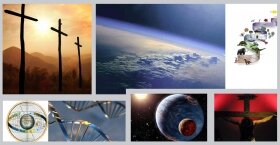
creation
Print »     creation
Send »     creation
Add »   Search
Subscribe

Share/Save/Bookmark

Back  
Moble Dictionary of Theology « Mobile » creation

« Main

 creation
 
The act of creating; especially, in a theological sense, the original act of God in bringing the world or universe into existence.
1 In the beginning God created the heavens and the earth. -Gen. 1:1

Creation is a doctrinal position in many religions and philosophical belief systems which maintains that a single God, or a group of gods or deities is responsible for creating the universe. Creationism affirms this belief, but the doctrinal belief is not necessarily synonymous with creationism.

Judaism & Christianity

Genesis 2:4-25

Mainstream Biblical scholarship maintains that the creation story found in Genesis 2 is the earlier of the two Genesis accounts. Filled with ancient and rich imagery, it is believed that the basic story once circulated among the early nomadic Hebrews, told perhaps around simple, intimate campfire settings, answering questions about life and the origins of humankind. The story also reflects Israel's belief in its covenant relationship with God. The concern in Genesis 2 is not in the creation of the cosmos but in the origins of humankind and their environment. There is a clear connection between humans and the land (Gen. 2:7) and the notion that people are a special creation of God. "Jehovah" is that name of God, which plainly means that he alone has His being of himself, and that He gives being to all creatures and things.
And God said, “Let there be light,“ and there was light. - Genesis 1:3, M 17 Omega Nebula, © NASA / Hubble
(larger image)

Orion Nebula taken by the Hubble Space Telescope.
(larger image, right click here and "save as" for 18K pixel version.)
7And Jehovah Elohim formed Man, dust of the ground, and breathed into his nostrils the breath of life; and Man became a living soul. -Genesis 2:7 (Darby)


Genesis 1:1-2:3

(see Genesis 1:1-2:3)Some Biblical scholars believe that the Genesis 1 account can be attributed to the so-called "priestly" writer(s)/editor(s) (known in academic circles as "P". P supposedly represents a Priest (or priests) who lived during the exile in Babylon and allegedly composed a code of holiness for the people)) who was responsible for a fair portion of the Pentateuch. However, see the Did Moses really write Genesis? article by Russell Grigg.
The evidence that Moses wrote the Pentateuch, often referred to in the Bible as ‘the Law’ (Hebrew Torah), is overwhelming.

Dating to roughly the Exilic and early post-Exilic period of Hebrew history, the account sets forth creation on a cosmic scale. Revered for its majestic poetry concerning the beginnings of the universe, the Genesis 1 account is shaped as a litany, likely for use in the First Temple in Jerusalem, though its basic form predates the building of the Second Temple.

Whereas the earlier account found in Genesis 2 emphasizes the closeness of humanity's relationship to the environment and the immanence of God, the later Genesis 1 account emphasizes the transcendent greatness of God and culminates in the establishment of the Sabbath. It is believed that the "P" source was concerned with maintaining a Jewish identity while removed from Jerusalem and Temple worship, and that the Sabbath was thus lifted up as a means to retain a distinctive identity in the midst of a pluralist Exilic culture. Hence, the account ends with the establishment of the Sabbath as an act of God, and an important part of the creative process.

This familiar account today is utilized for a variety of theological purposes.

It is often used to stress the transcendence of God, his sovereignty, awesome power, and identity as wholly separate from creation.

The account is typically used to establish or strengthen the notion of Sabbath as a key mark of God's "chosen people", particularly by Jewish scholars.

This is a key passage for those who support the notion of creatio ex nihilo, or "creation out of nothing". This belief states that God created the cosmos without the aid of anything to begin. Genesis 1:1 reads in Hebrew, "Bereshit bara Elohim et hashamayim ve'et ha'arets..". In most traditional English translations, it reads, "In the beginning, God created the heavens and the earth..". God's existence and creative power apart from any original "building blocks" is assumed. A notable exception to this translation appears in the NRSV translation, which reads, "In the beginning when God created the heavens and the earth..", which, while still faithful to the Hebrew text, seems to make the assumption that God created the universe out of "chaos". While this idea is found elsewhere in Scripture (notably in the Psalter), the NRSV is the first major English translation to find this notion in Genesis 1.

The first creation story found in Genesis is also the key passage for those who subscribe to some form of creationism, which purports that Genesis 1 is a literal account of how God created the universe (see article for more information).

The terms "hashamayim ve'et ha'arets" (translated as Heaven and Earth} is identical to the Sumerian term Anunaki (Anu=heaven, na=and, Ki=Earth {Sumerian)), the name given to the Gods in Southern Mesopotamia. By this means, author/redactors of the Babylonian exile were asserting the superiority of their god over the polytheistic gods of Babylonia (see also Babylon).


Psalms

YHVH as divine warrior Psalms 8, 33, 89, 98, 104, 145


Rabbinic Interpretation

A Jewish midrash or homiletical interpretation tells that six things preceded the creation of the world: the Torah and the Throne of Glory were created, the creation of the Patriarchs was contemplated, the creation of Israel was contemplated, the creation of the Temple in Jerusalem was contemplated, the name of the Messiah was contemplated, and repentance too. (Genesis Rabbah 1:4.)

The Mishnah teaches that God created the world with ten Divine utterances. Noting that surely God could have created the world with one utterance, the Mishnah asks: What are we meant to learn from this? The Mishnah answers: If God had created the world by a single utterance, men would think less of the world, and have less compunction about undoing God’s creation. (Mishnah Avot 5:1.)


New Testament

John 1
Colossians 1


Islam

Beginnings

Allah, in the Quran, says:
"Do not the Unbelievers see that the heavens and the earth were joined together (as one unit of creation), before we clove them asunder? We made from water every living thing." [21:30]

Islam, like the Judeo-Christian traditions, says that the universe was created in "days" or "steps":

"Verily your Lord is Allah, who created the heavens and the earth in six days, and is firmly established on the throne (of authority), regulating and governing all things." [10:3]

Several religions have creation stories, some of which account for the existence and present form of the Universe by the act of creation by a supreme being or the Creator God. Most of these accounts depict one or several gods fashioning things out of themselves, or from pre-existing material (for example chaos or prakriti).

The scholastic traditions of Judaism, Christianity, and Islam for the most part speak of creation ex nihilo (out of nothing). This is typified, for example, by the view that the first verse of the Christian and Jewish Bible ("In the beginning, God created the heavens and the earth") indicates the only self-existent entity is God with all other things deriving from God. 2 Maccabees 7:28 indicates that this philosophy may have been a common Jewish understanding of creation: "I beseech thee, my son, look upon the heaven and the earth, and all that is therein, and consider that God made them of things that were not ..". Similar to this is the language found in the Book of Hebrews, which states, "Through faith we understand that the worlds were framed by the word of God, so that things which are seen were not made of things which do appear". Some (notably ) also hold that God is altogether outside of time and that time exists only within the created universe.

However, in these traditions, the belief that God gave shape to pre-existing things was not unheard of, and that idea became more fully articulated especially under the influence of Greek philosophy. In both and , belief in creation "from nothing" clearly dominated the traditions sometime in the second century C.E., in part as a reaction against classical philosophy. The following story from the Talmud illustrates this:

A philosopher said to R. Gamiliel: Your God was a great craftsman, but he found himself good materials which assisted him: Tohu wa-Bohu, and darkness, and wind, and water, and the primeval deep. Said R. Gamiliel to him: May the wind be blown out of that man! Each material is referred to as created. Tohu wa-Bohu: "I make peace and create evil"; darkness: "I form the light and create darkness"; water: "Praise him, ye heaven of heavens, and ye waters" -- why? -- "For he commanded, and they were created"; wind: "For, lo, He that formeth the mountains, and created the wind"; the primeval deep: "When there were no depths, I was brought forth". BR 1.9, Th-Alb:8

Departing from this tradition, some modern scholars have argued that these statements and all others are still susceptible to ambiguous interpretation, so that creation ex nihilo may not be clearly supported by ancient texts, including the Bible. They point out the similarities of the biblical account, to other ancient religious beliefs that the universe was created by God or the gods out of pre-existing matter (demiurge), as opposed to "out of nothing". Some scholars see evidence that the biblical account, like other ancient religious views, presumes pre-existence of some kind of raw material, albeit without form: "Now the earth was formless and void, darkness was over the face of the deep, and the spirit of God hovered over the waters." God then fashions the disordered material, to create the world.

Joseph Campbell wrote extensively on the subject and considered creative mythology a means to reconcile the waking consciousness to the mysterium tremendum et fascinans of this universe as it is. In his book The Masks of God: Creative Mythology he explains that the retelling of the creation myth would render an interpretive total image of creation to be known to contemporary culture. Renewing the act of the experience of creation the existence of adventure is renewed, “at once shattering and reintegrating the fixed already known, in the sacrificial creative fire of the becoming thing that is no thing at all but life, not as it will be or as it should be, as it was or

Metaphysical creation possibilities

Creation stories at their outset being with either of two possibilities: demiurge or creation ex nihilo (Latin: out of nothing. In the first case, the universe is assumed infinite in existence, though the present order of the universe is derived from some organizational initiative, often precipitated by a
deity. In creation ex nihilo, the universe appears from "nothing": a state of non-existence.

Demiurge

Many nontheistic beliefs or religions that rely on less-than omnipotent deities adopt an infinite universe that exists for all time. Most influentially to Western thought, the Ancient Greeks believed that the present order was borne out of an initial state of chaos in a process known as the demiurge.

Creation ex nihilo

Adherents to the three Abrahamic religions and most Western theologians have embraced an ex nihilo creation as consistent with the scriptural narratives.
 
Sunset
Sunset
(larger image)
An explanation advanced by some theists is that God created the Universe out of nothing; some creationists hold also that life was created in something like its present state of variety, so that organisms were fully speciated from the beginning. While there are various attempts to square these ideas with available evidence and currently accepted theory, their explanatory utility, predictive power, and scientific standing are questioned by critics of creationism. Many scientists in the relevant fields, theist and otherwise, do not regard notions like divine power or divine will as playing scientific roles in cosmology or biology (see also Creationism).
According to some scientists, creation ex nihilo is at odds with our everyday experiences, in that nothing spontaneously comes into (or vanishes from) existence but instead matter and energy merely change forms. However, quantum mechanics allows for energy to be spontaneously created from the vacuum as long as the Heisenberg Uncertainty Principle is not violated (usually, by the spontaneous annihilation of the created particles, e.g. the Lamb shift). This may give a means by which creation ex nihilo can be reconciled with currently understood science, although the doctrine asserts that God created the scientific laws ex nihilo as well and is not subject to them, but nevertheless we are not currently able to explain creation ex nihilo, nor even to prove that it is required. Julian Barbour suggests that reality simply terminates on nothing at the alpha point, as a brute fact, in the same way that England abuts the sea at Land's End without requiring an explanation.

Scientific observations

Science, strictly speaking, deals only with observable phenomena. Anything that cannot be observed (either directly or indirectly) is, by definition, not a subject of scientific investigation. Scientists look for patterns among observations, which give rise to hypotheses to be tested against further observations. If a hypothesis passes these tests, it is then called a scientific theory, which again is subject to amendment or rejection based on new observations.

Using verifiable observations science is able to measure some of the effects of past events of evolution of the early universe (for instance, via the microwave echo of the big bang) and interpret these observations within a scientific framework. By extrapolating the current observed state of affairs into the past, scientists seek to construct an accurate picture of the past. Those who are strict adherents to philosophical naturalism believe that such is all that is possible to know. This is not a universally accepted idea by any means, and there are many who promote other paths to knowledge which are not characterised as scientific inquiry.

In scientific theories supported by the mainstream scientific community, the universe and life is described as developing through solely natural causes, and the progress of science is hoped to continue to improve the explanation of things and events in the past.

Mainstream scientific theories

The Big Bang, one cosmological theory about the early development and current shape and evolution of the universe, is supported by a collection of observed facts. It places origin of the Universe at about 13.7 +/-0.5 billion years ago. This widely accepted scientific dating contradicts many religious accounts of creation - for example, certain creationist accounts consider the Universe to be only a few thousand years old. The preconditions for the Big Bang are currently a subject of developing theories (e.g. cosmic inflation theory).
However, in “The Cambrian Explosion,” Stephen C. Meyer, Marcus Ross, Paul Nelson, and Paul Chien show that the pattern of fossil appearance in the Cambrian period contradicts the predictions or empirical expectations of neo-Darwinism and other materialistic theories of evolution. They argue that the fossil record displays several features—a hierarchical top-down pattern of appearance, the morphological isolation of disparate body plans, and a discontinuous increase in information content—that are strongly reminiscent of the pattern of evidence found in the history of human technology. Thus, they conclude that intelligent design provides a better, more causally adequate, explanation of the origin of the novel animal forms present in the Cambrian explosion.
© The Cambrian Explosion: Biology's Big Bang

The solar nebula which coalesced out of gas and dust about 4.3 billion years ago is considered the best planetary system formation model available for explaining the origin of the solar system. The Earth-moon system was formed out of this and there is evidence that the two bodies were formed after a collision between the proto-Earth and a Mars-sized object.

Grand Canyon National Park, Arizona, U.S.A
The Grand Canyon National Park, Arizona, U.S.A

(larger image)
The modern evolutionary synthesis is the dominant biological theory about the origin of human life on Earth. This combines Charles Darwin's theory of the evolution of species by natural selection with Gregor Mendel's theory of genetics as the basis for biological inheritance.

The origin of life itself on Earth is more contested. The scientifically prevalent view is that life originated on Earth, although other views hold that organic compounds from comets may have been an important source of material for the appearance of life. The Miller-Urey experiment showed that amino acids could arise from a type of primitive environment. Nevertheless, while scientific research on abiogenesis is ongoing, there is no consensus on how life began. Scientific conjectures, hypotheses, and observations pertaining to this topic are detailed in the article on the origin of life.

It should be pointed out that the above scientific theories are not ex nihilo beliefs, that is they do not start from nothing. They provide no mechanism for the origin ex nihilo of energy or matter. In this respect they are unlike the Jewish, Christian, and Islamic beliefs which assert that the universe, Earth, and life originated in a unique creative act by a superior cosmic being (In these religions it is a single deity), or scientific speculations which propose an original cause of some other type. For a more precise understanding of modern science's concepts concerning "matter from vacuum" or "something from nothing" see virtual particle and vacuum energy.

Beliefs grounded in philosophical naturalism

Atomism is an ancient Greek philosophy supported by Democritus, Epicurus and Lucretius which held that events in the universe were not the consequence of any act by a Creator, but rather was the result of atoms moving about randomly. This philosophy was reformulated as determinism after the Enlightenment and still enjoys a following by some scientists, though the character of deterministic interactions in nature involving quantum mechanics is an outstanding question.

The Anthropic Principle and its more controversial derivative the Strong Anthropic Principle are explanations for the existence of humanity with respect to the conditions of the universe that we inhabit. The principle is used as a guide for some scientists to determine certain physical laws that have necessarily resulted in the existence of ourselves. In some sense, the Anthropic Principle is an empirical truism while the Strong Anthropic Principle is an idea that may defy falsification.

Deism was a popular belief of many scientists and philosophers of the post-enlightenment, including Newton, Leibniz, and Thomas Jefferson that kept the formality of a creator, but allowed creation to function solely based on natural laws that were established at the time of creation. In this formulation, every interaction was completely deterministic.

The Many worlds interpretation of quantum mechanics and the idea of parallel universes are ways of resolving questions of causality and determinism in the framework of probabilistic interactions. In this speculative interpretation, the universe that we inhabit is one of many possible universes that all simultaneously exist, but are independent of each other, and each universe bifurcates with every quantum mechanical "observation".

Limits to the ontology of origins

While many scenarios are proposed by religion and science to identify 'first cause' and the origin of creation (ontology), there are some fundamental limits to the knowledge of humankind that present a barrier to finding any definitive answer.

Post-modern philosophy currently holds that there is nothing that one can know for certain. Immanuel Kant's philosophy can be seen as a forerunner of this idea — that because we view the universe through the lens of the mind, which is 'shaped' by space, time, and the things embedded in space and time, it is not possible to see things-in-themselves (noumena) - the real objects that lie behind the subjective objects (phenomena) we recognise. If true, it is beyond the mind of humankind to perceive a condition that has no space or time. Many other philosophers, most recently Popper have all shown that there is precious little one can be sure of that would provide a starting point to determine the 'first cause' that led to creation.

Modern physics is an empirical science based on experiment and observation that characterizes how things happen through scientific theories and physical laws, but ultimately does not answer the question of 'why' things happen at the foundational (ontological) level. For example, the existence of the Big Bang is not predicated on a reason for its occurrence. What's more, the modern physics breaks down at the Planck time/Planck length, where both the influences of quantum mechanics and gravity are required to be combined in order to characterize the interactions that occur. As such, there is no model available that has been tested at this level, and so any attempt to theoretically probe beyond this regime in search of a more fundamental appreciation of the nature of the universe is hampered.

Religion has philosophy and oral testimony available to it to demonstrate a God or a separate "first cause" that called the universe into existence. As such it is dependent on faith in God or the specific "first cause" to which it ascribes.

see also:
Kalam cosmological argument,
Cradle of Humanity,
Creation science

Site this page:

Timothy Ministries Dictionary of Theology. http://timothyministries.org 2005-2010.
"Creation"  < http://timothyministries.org/theologicaldictionary/references.aspx?theword=creation >   Retrieved: Jul 30 2010 4:55AM
#twurch


related to your query 
Gospel of Johngo »
Johnson C. Philipgo »
jihadgo »
Hamasgo »
Radical Islamgo »
123
Translate a word/phrase

Translate creation to:
Other Items
Torrey's creation
Nave's creation
Easton's creation
Eurekster creation
Add td Search
to your Site.


Short Description
The act of creating; especially, in a theological sense, the original act of God in bringing the world or universe into existence. 1 In the beginning God created the heavens and the earth. -Gen. 1:1 Creation is a doctrinal position in many religions and philosophical belief systems which maintains that a single God, or a group of gods or deities is responsible for creating the universe. Creationism affirms this belief, but the doctrinal belief is not necessarily synonymous with creationism. ... more
Some of the information in this database has been extracted in whole or in part with and without modifications from http://en.wikipedia.org in accordance with their copyleft policy, also known as "Share-alike".

Some of these terms may have been extracted from http://en.wikipedia.org/wiki/ » creation under the terms of the GNU Free Documentation License.

Permission is granted to copy, distribute and/or modify this document under the terms of the GNU Free Documentation License, Version 1.2 or any later version published by the Free Software Foundation; with no Invariant Sections, with no Front-Cover Texts, and with no Back-Cover Texts.

A copy of the license is included in the section entitled "GNU Free Documentation License".
Readers, a word of caution about Wikipedia articles. Wikipedia articles are edited by volunteers. The only necessary qualifications to become a Wikipedia editor are:
  • willingness to contribute and
  • Internet access
and therefore, some Wikipedia articles may not be reliable since an editor could literally be anyone.

For further information about the reliability of Wikipedia articles, see the article: Reliability of Wikipedia

2005-2010 TimothyMinistries.org
Timothy Ministries is an IRS approved non-profit 501(c)(3) organization.
#twurch