Dictionary of Theology :: Timothy Ministries Clare Cottage 1724 Crescent Drive Beloit, WI 53511 USA Phone:(608) 365-7322 Fax:(608) 365-7322
Timothy HOME Timothy Past Timothy Present Timothy Future Timothy Contacts
Creationism
Print »     Creationism
Send »     Creationism
Subscribe

Share/Save/Bookmark
Back  
Moble Dictionary of Theology « Mobile » Creationism

« Main

 Creationism
 
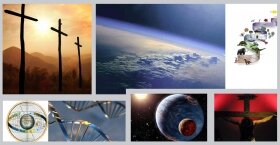
Creationism or "creation theology" encompasses the belief that human beings, the world and the universe were created by God.

In Abrahamic religions, creationism or creation theology is the origin belief that humans, life, the Earth, and the universe were created by a supreme being or deity's supernatural intervention. The intervention may be seen either as an act of creation from nothing (Ex nihilo).

And God said, “Let there be light,“ and there was light. - Genesis 1:3
(larger image)
Many who hold "creation" beliefs consider such to be an aspect of religious faith which is compatible with (or otherwise unaffected by) scientific views. A popular example of such a belief would be that God created the Earth, and also created evolution in order for earth to sustain life over a long period of time.

Others may claim that scientific data supports creationism, or rather rejects the paradigm of evolution. Yet others may hold to a more literal interpretation of creationism, and may claim that science and empirical rationalism are incompatible with religious belief —and thus to be held in a lower regard. Because creationism is largely defined in religious terms, and because the meaning of "literal interpretation" has great variance, "creationism" (in common usage) typically connotes a religious, political, and social campaign (i.e. in education) to assert the dominance or widespread acceptance of a spiritual view of humanity, and to designate other views as materialistic and inferior. In this aspect, and within local contexts where creationism has been promoted, some critics claim that creationism is simply a device —to promote Christianity, and to undo any functional separation of church and state.

Those who hold literal creation views often reject views of science and certain scientific theories in particular. Most notable is the rejection of evolution and its implications for current evolutionary biology. While the general idea of natural selection may fit into various particular views, the evolutionary (see: evolution) concept of common descent —that humans are "descended from lesser creatures" — is a point of great issue with most creation believers. Most creationists also dispute evolutionary theories about the origin of life, origin of the human species, the geological history of the Earth, the formation of the solar system, and the origin of the physical universe. Proponents of theistic evolution may claim that understood scientific mechanisms are simply aspects of supreme creation. They, as well as other science-oriented believers, may consider the scriptural account of creation as simply a metaphor, albeit one with meaning beyond the understanding of current science.

The term creationism is most often used to describe the belief that creation occurred literally as described in the book of Genesis (for both Jews and Christians) or the Qur'an (for Muslims). Although the Hebrew Bible may be translated to implicitly deny "creation out of nothing" (creatio ex nihilo) and, according to some scholars, may even suggest differing accounts of creation, some Jews and Christians use Genesis exclusively as a support of their beliefs about origins.

Creation according to Genesis refers to the description of the creation of the heavens and the earth by God, as described in Genesis, the first book of the Bible. The text spans Chapter 1 and Chapter 2 of the book of Genesis. The original Hebrew has been translated into English on innumerable occasions; the most famous of these is the King James version.

Genesis is part of the canonical scriptures for both Christianity and Judaism, and to a lesser degree Islam, and thus to believers is taken as being of spiritual significance. For a discussion of the comparison between the first two chapters of Genesis and the theory of evolution, see Creation vs. evolution debate.

The opening of Genesis tells the biblical story of creation. Genesis 1 verse 1 begins with the description of how God (Elohim) created Heaven and Earth. The text thus begins by establishing a series of dualisms (heaven and earth, dark and light, day and night etc.) by which the created order is progressively established, with God creating by means of the movement of his "spirit" (ruach) moving across the deeps (tehwom). Creation is established both by speaking (e.g. "Let there be light") and actively working ("dividing the light from the darkness") over a period of six days.

For those that take Genesis as a literal account, this indicates what occurred on six successive days of 24 hours each. Alternatively, there are those that point to the fact that the first day occurred before the creation of sun and moon (on the fourth day) thus justifying an allegorical interpretation of the story. Many of this persuasion claim it to be a description of humankind's development of a relationship between creation and the creator. The level to which the story is taken at its literal meaning is in part related to how theologically conservative or theologically liberal the interpreter is, or the degree to which one accepts or rejects a belief in the inerrant nature of the Biblical text.

According to many of the Hebrew and Christian traditions, the first 5 books of the Bible, or Pentateuch, were written by Moses. John the Evangelist presents Jesus as having accepted Mosaic authorship (John 5:46–47).

It is often accepted that parts of the Pentateuch were added by later authors. Most commonly cited is Deuteronomy 34, which records the death of Moses. Many Liberal Christians and unbelievers claim that this shows that the claim of total and exclusive Mosaic authorship is disproven. Traditionalists claim that it was Joshua appended this to Moses' writings, just as many copies of Shakespeare mention his death. But like the rival claims about Shakespearian authorship, this , so some Liberals and unbelievers claim, opens the door to the questioning of the authorship of other passages of Genesis. There are, however, a number of other passages that may indicate that Moses wrote texts, which may be part of the Pentateuch as a whole; e.g. Exodus 17:14; 24:4–7; 34:27; Numbers 33:2; Deuteronomy 31:9, 22, 24, but no passage explicitly ascribes the book of Genesis to Moses. (Benware 1993)

However, traditionalists argue that Moses seems to have all the right criteria to be the author. The books show immense familiarity with the customs, geography, fauna and flora of Egypt, which is consistent with an author who grew up there. But there is a curious naivety about Palestine, which seems inconsistent with being written after Israel was a nation.Several possibilities have been suggested as to how Moses came to write the text:

  • he may have received it all by oral traditions, passed down over the centuries from father to son, which he then collected and wrote down, (Morris 1981).
  • he may have taken actual written records of the past as part of his education as an Egyptian prince, collected them, and brought them together into a final form. (Douglas 1990). Or as leader of the Israelites, he may have been in possession of written records of the past handed down from the Israelite ancestors, thus providing the possibility of direct witness to the events by the authors.
  • he may have received it all by direct revelation from God, either in the form of audible words dictated by God and transcribed by him, or else by visions given him of the great events of the past, which he then put down in his own words. (Morris 1981).

Some believe that Moses wrote the Pentateuch by the inspiration of the Holy Spirit. Others believe that Moses wrote the text, but not under any divine inspiration.Critics argue that belief in Mosaic authorship is unjustified because the text does not claim to be written by Moses; because large portions of the text were written about events long before Moses lived, or (in a few cases) after he died, were therefore not firsthand knowledge, and must have originated elsewhere; and because stylistic, vocabulary, and structural changes exist in the text indicating multiple authors and redaction.A computer study was undertaken to determine the authorship of Genesis. The study concluded that it was produced by a single author, and that the author had major Egyptian influences. Omni magazine of August 1982 says:

After feeding the 20,000 Hebrew words of Genesis into a computer at Technion University in Israel, researchers found many sentences that ended in verbs and numerous words of six characters or more. Because these idiosyncratic patterns appear again and again, says project director Yehuda Radday, it seems likely that a sole author was responsible. Their exhaustive computer analysis conducted in Israel suggested an 82 percent probability that the book has just one author.

Modern textual critics posit that the first two chapters of Genesis are a composite of two different literary strands: the "Jehovist" (10th century BC), and the "Priestly" (7th century BC); and that the strands were compiled by an unknown redactor. One such scholar wrote, "The book of Genesis, like the other books of the Hexateuch, was not the production of one author. A definite plan may be traced in the book, but the structure of the work forbids us to consider it as the production of one writer." (Spurell xv).The postulated source streams include:

  • Genesis 1:1 to 2:3, which exclusively uses the word Elohim to describe God, is ascribed to the Priestly source, which biblical critics believe to have used only Elohim until the revelation of the Name (in Exodus 6:3).
  • Genesis 2:4 to 2:24, which exclusively uses the words Yahweh Elohim to describe God, is ascribed to the Yawhist, who biblical critics believe used Yahweh exclusively.

see also: the names of God

Textual critics assert that the two passages tell the story of creation in different ways, and that there are inconsistencies between the two accounts. They conclude that the most probable explanation for the two inconsistent accounts is that a redactor combined the two independent creation stories into the final text which we have today. Bible defenders argue that the inconsistencies are apparent rather than real.

Those rejecting the methodology of textual criticism argue that when a biblical text is measured against the scholar's own concept of unity and found wanting, this probably says more about the biblical scholar's sense of unity than about the text's prehistory. (Carr 24).

The JEPD hypothesis has also been criticized on the grounds that it apparently must even attribute different parts of individual sentences to different authors, since many sentences in Genesis refer to God both as Elohim and Jehovah. A good example is Genesis 2:4 through the end of chapter 3, where all 19 times the name "Jehovah" is found, it is followed immediately by "Elohim" (God).

Many of Julius Wellhausen's assumptions are no longer held today, e.g. that there was no writing at the time Moses was alleged to have written. Also, J. P. Holding has shown that Deuteronomy is written as a suzerain–vassal treaty in the form common from 1400 to 1200 BC, centuries before the time Wellhausen thought it was written.

Some scholars believe that the Genesis account is a report of creation, which is divided into two parts, written from different perspectives: the first part, from 1:1 to 2:3, describes the creation of the Earth from God's perspective; the second part, from 2:4-24, describes the creation of the Garden of Eden from Humanity's perspective. One such scholar wrote, "[T]he strictly complementary nature of the accounts is plain enough: Genesis 1 mentions the creation of man as the last of a series, and without any details, whereas in Genesis 2 man is the center of interest and more specific details are given about him and his setting." (Kitchen 116-117).

Other scholars, particularly those ascribing to textual criticism and the Documentary hypothesis, believe that the first two chapters of Genesis are two separate accounts of the creation. (They agree that the "first chapter" should include the first three verses of chapter 2.) One such scholar wrote: "The book of Genesis, like the other books of the Hexateuch, was not the production of one author. A definite plan may be traced in the book, but the structure of the work forbids us to consider it as the production of one writer." (Spurell xv). The distinction between the 'two' creation stories is concealed by some translations, such as the New International Version. For some religious writers, such as Rabbi Joseph Soloveitchik, the existence of two separate creation stories is beyond doubt, and thus needs to be interpreted as having divine importance.

Other scholars, such as Pamela Tamarkin Reis, assert that the text can be read either as one account or as two accounts from different perspectives, as the text uses a literary device to describe the same events first from the perspective of God, and second from the perspective of Humanity. According to the documentary hypothesis the existence of two creation stories is the result of the merging of two distinct traditions into one unified text. Literary and linguistic analysis by various authors offer a number of theories concerning modifications and editing which produced the text that exists today. Some readers of the Bible deny that two distinct creation stories exist; they have created a detailed set of religious readings which attempt to show that any differences are only apparent, but not actually real.

Literary intent

  • Some understand the passage literally, as meaning that God created the Earth exactly as described.
  • Some interpret the passage figuratively, as meaning that God created the Earth and Life by his own power, that he created it Good, that he entrusted it to Humankind; since they see such power in the allegory, they see no reason to necessarily understand the passage literally.

"In the Beginning"

  • Some understand the text to refer to the creation of the entire universe, and translate the first verse of Genesis as "In the Beginning." Related to this is the belief in creatio ex nihilio, creation out of nothing.
  • Some understand the text to refer to the creation of the entire universe, but suggest that God must have withdrawn some of his own being to make room for the creation. Related to this are various beliefs meant to explain the presence of evil in the world
  • Some understand the text to refer to the creation of order in the universe. They point out that In the beginning is not a literal translation of the Hebrew text into English. The Hebrew text lacks the definite article, and many have suggested it should be translated as When God began to create the heaven and the earth. This interpretation implies that there was unordered matter in the universe before God began to order it, and implicitly rejects the doctrine of creatio ex nihilio.

Timescale

  • The dual account theory asserts that the first story describes the creation of plants, animals, and humans over a period of many days, the second story describes these things of happening on the same day.
  • The single account theory asserts that the first segment of the story describes the creation of plants, animals, and humans of the course of several days, and the second segment picks up where the first leaves off, focusing on the creation of the Garden of Eden, and the creation of domesticable plants, ("plants of the field and herbs of the field");

Use of different words for God

  • The first section exclusively refers to God as Elohim (often translated God), whereas the second exclusively uses the composite name Yahweh Elohim (the former word is often "translated" Lord or LORD, though it is sometimes rendered as God).
  • The single account theory asserts that Hebrew scriptures use different names for God throughout, depending on the characteristics of God which the author wished to emphasize. They argue that across the Hebrew scriptures, the use of Elohim in the first segment suggests "strength," focusing on God as the mighty Creator of the universe, while the use of Yahweh in the second segment suggested moral and spiritual natures of deity, particularly in relationship to the man. (Stone 17).
  • The dual account theory asserts that the two segments using different words for God indicates different authorship and two distinct narratives, in accord with the Documentary hypothesis.

Though not so obvious in translation, the Hebrew text of the two sections differ both in the type of words used and in stylistic qualities. The first section flows smoothly, whereas the second is more interested in pointing out side details, and does so in a more point of fact style.

  • One of the principles of textual criticism is that large differences in the type of words used, and in the stylistic qualities of the text, should be taken as support for the existence of two different authors. Proponents of the two-account hypothesis point to the attempts (e.g. The Book of J by David Rosenburg) to separate the various authors of the Torah claimed by the Documentary Hypothesis into distinct and sometimes contradictory accounts.
  • Proponents of the single account argue that style differences need not be indicative of multiple authors, but may simply indicate the purpose of different passages. For example, Kenneth Kitchen, a retired Archaeology Professor of the University of Liverpool, has argued (1966) that stylistic differences are meaningless, and reflect different subject matter. He supports this with the evidence of a biographical inscription of an Egyptian official in 2400 B.C., which reflects at least four different styles, but which is uniformly supposed to possess unity of authorship. Similarly, the different names of God reflect his different attributes.

The single account theory asserts that it is unlikely that the text would have survived for three to four thousand years in such an obviously contradictory state, and that it is therefore much more likely that the two segments are consistent with each other, with the first being general and the second being more specific to the creation of humans and the garden.However, those who argue that the differences in the accounts are irreconcilable point to several historic factors that would have allowed the contradictory accounts to survive uncorrected. Prior to the modern era, factors that would have made correction difficult included mass illiteracy, hand copying of manuscripts prior to the printing press, early rules preventing translations of the scriptures into common languages, church discouragement and punishment of critical analysis of scripture, and the church's canonization of texts as they were. In early times, there were few incentives or opportunities to criticize or correct scriptural text.

How apparent the differences are depends on the translations. For example, some modern English Bibles translate the two different words for God--Yahweh and Elohim--both as God. Others, however, such as the King James and Revised Standard Versions, translate Elohim as God, and Yahweh as Lord. In addition, some translations (e.g. the New International Version) have rendered the start of the second section as the day when, since the Hebrew beyom ("in the day") is an idiomatic expression for "when". So the NIV regards Ch. 2 as a review of past events--rather than the literalistic on that day, as if it were a first recording of events.

Biblical scholar Pamela Tamarkin Reis (2001) proposes that Genesis 1 and 2 can be seen as either one story from two perspectives or two separate stories. Both are appropriate. She draws the parallel with the ancient story-telling technique of telling the same sequence of events through the eyes of several different people. This method is best known from its use by Kurosawa in the movie Rashomon. One can make sense of that movie either as four different stories or as four people having four different realistic narratives of the same story.Ms. Reis analyzes Genesis 1 as God's narrative and Genesis 2 as man's narrative. In Genesis 1, the style of narration is very orderly and logical, proceeding from basics like heaven and earth, through plants and animals to man and woman. And everything is "good" or "very good." Ms. Reis suggests that the story-teller has a bit of whimsy in noting how perfect everything is from God's view.

In contrast, in Genesis 2, man tells the story from his own self-centered perspective. Man is created first, and there are a few flaws. For example, Man is alone, without a woman (in contrast to Genesis 1, where the two were created simultaneously). Where Genesis 1 repeats the phrase "heaven and earth" several times, Genesis 2 uses "earth and heaven." Moreover, Genesis 2 contains a notice that "there was no one to till the ground." The implication that the ground must be tilled contrasts with the completeness implied in Genesis 1.

Even the words used in Genesis 1 suggest serenity, the godly plane of existence. For example, in Genesis 1, the word for God is Elohim, the generic and distant God, while God's name in Genesis 2 is the personal and sacred YHWH Elohim, the Lord of Gods. Even the verb of making is different in the two narratives; in the first narrative the verb is the Hebrew "arb" which means "create from nothing," something that only God can do. In contrast, the verb in the second narrative means "make;" God "made earth and heaven." Furthermore, Man and Woman are both formed from pre-existing matter, in contrast to their creation ex nihilo in the first chapter. This brings God's act within the range of human experience. There are also details about where to find gold and lapis lazuli--but only in the second narrative.

Ms. Reis argues that Genesis 1 and 2 make sense either way, just as for Kurosawa's Rashomon. They make sense as two different stories. Or they make sense as two narratives of the same story from different personal perspectives: that of God and that of man.

The terms creationism and creationist have become particularly associated with beliefs conflicting with the theory of evolution by natural selection. This conflict is most prevalent in the United States, where there has been sustained creation-evolution controversy in the public arena. On the other hand, many faiths, including Abrahamic denominations, which believe in divine creation, accept evolution by natural selection, as well as, to a greater or lesser extent, scientific explanations of the origins and development of the universe, the Earth, and life – such beliefs have been given the name "theistic evolution" or "evolutionary creationism".

In a Christian context, many creationists adopt a literal interpretation of creation narratives, and say that the Bible provides a factual account, given from the perspective of the only one who was there at the time to witness it: God. They seek to harmonize science with what they take to be an eye-witness account of the origin of things (see Young Earth Creationism, for example). However, scientific evidence as an empirical source for information on natural history is usually interpreted as contradictory to the Bible, but can be interpreted as supporting it, depending on the presuppositions that are held.

Almost all churches teach that God created the cosmos, but some Christian scholars (Roman Catholic, Anglican and Lutheran), now reject reading the Bible as though it could shed light on what the events of creation were, which they now conclude are best understood in a naturalistic way. Similarly, liberal theology assumes that Genesis is a poetic work, and that human understanding of God increases gradually over time; and just as understanding of God grows, human understanding of God's will and of the world also grows, and has grown since Biblical times.

However, many believers in a literal interpretation argue that once a poetic view of the creation account in Genesis has been adopted, it leads one to question the historicity of other central topics of that book. Furthermore, the liberal (see: liberalism) approach suggests, sometimes outright, that Jesus as seen in the New Testament, or the writers of the Bible, had a mistaken understanding of the reliability of the Bible, and erroneously believed the book of Genesis to be literal history: a proposition that, if adopted, has radical implications for Christian faith and the reliability of the Bible.

In the secular sense, "creationism" refers to a political doctrine which asserts the validity and superiority of a particular religiously-based origin belief over those of other belief systems, including those in particular espoused through secular or scientific rationale — i.e. "Creation-evolution controversy." The meaning of the term "creationism" depends upon the context wherein it is used, as it refers to a particular origin belief within a particular political culture.

In the United States, more so than in the rest of the world, creationism has become centered in political controversy, in particular over public education, and whether teaching evolution in science classes conflicts unfairly with the creationist worldview. Currently, the controversy has come in the form of whether advocates of the Intelligent Design movement who wish to "Teach the Controversy" in science classes have overstepped the boundaries of separation of church and state.

Creation Science refers to the endeavour of self-described "creation scientists" to use science in support of a creationist worldview. The scientific status of Creation Science is disputed by most of the scientific community as pseudoscience because Creation Science begins with a desired answer and attempts to interpret all evidence to fit in with this predetermined conclusion. According to the philosophy of science, scientific investigation uses the scientific method to formulate theories and predictions based only on accurate observations. Imposing such limitations is equivalent to assuming that phenomena have naturalistic descriptions, and creationists argue that this is effectively an imposition of an atheistic bias since most scientists claim, for example, that the action of a deity has never been observed.

The history of creationism is tied to the history of religions. Creationism in the West primarily had some of its earliest roots in Judaism. For example, Abraham ibn Ezra's (c. 1089–1164) commentary on Genesis is greatly esteemed in traditional rabbinical circles and he was a creationist. (for more about creationism in Genesis see: Answers in Genesis)

In the 18th and 19th centuries, naturalists challenged the Biblical account of creation as to be in conflict with empirical observations of natural history from scientific inquiry. Creationists consider their primary source to be the ancient Hebrew text describing creation according to Genesis. While the term creationism was not in common use before the late 19th century they see themselves as being the philosophical and religious offspring of the traditions that held that text sacred. The biblical account of history, cosmology and natural history was believed by Jews, Christians and Muslims and its accuracy was unquestioned through the Medieval period. Most people in Europe, the Middle East and other areas of the Islamic world believed that a supreme being had existed and would exist eternally, and that everything else in existence had been created by this supreme being, known variously as God, Yahweh, or Allah. This belief was based on the authority of Genesis, the Qur'an, and other ancient histories, which were held to be historically accurate and no systematic or scientific inquiry was made into the validity of the text.

Islamic scholars preserved ancient Greek texts and developed their ideas, leading to the Renaissance which brought a questioning of biblical cosmology. With the Enlightenment a variety of scientific and philosophical movements challenged traditional viewpoints in Europe and the Americas. Natural history developed with the aim of understanding God's plan, but found contradictions, which in revolutionary France were interpreted as science supporting evolution. Elsewhere, particularly in England, clerical naturalists sought explanations compatible with interpretations of biblical texts, anticipating many later creationist arguments.

While the concept of an ancient earth became widely accepted, Charles Darwin's theory of natural selection directly challenged belief in God's involvement in creating species, and in response Creationism arose as a distinct movement aiming to justify and reassert the literal accuracy of sacred texts, particularly the words of Genesis.

The history of creationism has relevance to the creation-evolution controversy. Proponents of creationism claim that it has a rich heritage grounded in ancient recorded histories and consistent with scientific observation, whereas opponents, particularly of what they regard as the pseudosciences of creation science and intelligent design, claim that those are a modern reactionary movement against science.

Creationism covers a spectrum of beliefs which have been categorized into the broad types listed below. Not all creationists are in dispute with scientific theories, though very few modern scientists are creationists.

Young-Earth Creationism

The belief that the Earth was created by God a few thousand years ago, literally as described in Creation according to Genesis, within the approximate timeframe of the Ussher-Lightfoot Calendar or somewhat more according to the interpretation of biblical genealogies. (They may or may not believe that the Universe is the same age.) It rejects not only radiometric and isochron dating of the age of the Earth, arguing that they are based on debatable assumptions, but also approaches such as ice core dating and dendrochronology. Instead, it interprets the geologic record largely as a result of a global flood. This view is held by many Protestant Christians in the USA, and by many Haredi Jews. For Christian groups promoting this view, see the Institute for Creation Research (ICR), El Cajon, California, USA, and the Creation Research Society (CRS), Saint Joseph, Missouri, USA. Because Young Earth creationists believe in the literal truth of the description in Genesis of divine creation of every "kind" of plant and creature during a week about 6,000 years ago, they dispute parts of evolution (specifically Universal Common Ancestry) which describes all species developing from a common ancestor without a need for divine intervention over a much longer time. Different young-earth creationists offer different explanations for the fossil record, which gives the appearance that the Earth is much older:

Modern geocentrism

The view that God recently created a spherical world, and placed it in the center of the universe. The Sun, planets and everything else in the universe revolve around it. All scientific claims about the age of the Earth are lies; evolution does not occur. Very few people today maintain such a belief. See, for example, the Creation Science Association for Mid-America, in Cleveland, MO, USA.

Omphalos hypothesis

God created the Earth only recently, but made it appear much older. This is the belief of a small subgroup of Young Earth creationists, which is sometimes termed the Omphalos hypothesis. This argument was first made by Philip Henry Gosse in 1857. He held that because the world operates in cycles (chicken to egg to chicken on so on), certain physical and biological processes need the appearance of age to function. It is termed the Omphalos hypothesis because it is based on the question of whether or not Adam (or Eve for that matter) had a navel (given that they were created as adults rather than born, they can be assumed to have never possessed an umbilical cord). Gosse postulated that Adam did have a navel because it is how humans are formed. So the appearance of history (the belly button) is there, even though he was just created. He likewise postulated that for the earth to work, it must have been established with the appearance of age to function correctly. While many creationists hold this view for some smaller aspects of creation, for example the existence of the fossil record, the argument has been largely superseded.

Flood Geology

The view that God created the Earth only recently, and the fossil record is the record of the destruction of the global flood recorded in Genesis. The present diverse land animals are all descendants of the animals on Noah's Ark, having heavily diversified after the flood. A variety of mechanisms is suggested to be involved, including genomic modularity -- the ability for animals to reorganize their genome in response to stress or other outside influence, heterozygous fractionation (heterozygous genes in parents can lead to speciation by having multiple homozygous genes in children), and standard evolution.
see also Flood geology

Old-Earth Creationism

The view that the physical universe was created by God, but that the creation event of Genesis is not to be taken strictly literally. This group generally believes that the age of the Universe and the age of the Earth are as described by astronomers and geologists, but that details of the evolutionary theory are questionable.

Old-Earth creationism itself comes in at least three types:

Gap creationism

(also called "Restitution creationism")

The view that life was immediately created on a pre-existing old Earth. This group generally translates Genesis 1:2 as "The earth became without form and void," indicating a destruction of the original creation by some unspecified cataclysm. This was popularized in the Scofield Reference Bible, but has little support from Hebrew scholars.

Day–age creationism

The view that the "six days" of Genesis are not ordinary twenty-four-hour days, but rather much longer periods (for instance, each "day" could be the equivalent of millions of years of modern time). This theory often states that the Hebrew word "yôm", in the context of Genesis 1, can be properly interpreted as "age." Some adherents claim we are still living in the seventh age ("seventh day").

Progressive creationism

The view that species have changed or evolved in a process continuously guided by God, with various ideas as to how the process operates (often leaving room for God's direct intervention at key moments in Earth/life's history). This view accepts most of modern physical science including the age of the earth, but rejects much of modern evolutionary biology or looks to it for evidence that evolution by natural selection alone is incorrect. This view can be, and often is, held in conjunction with other Old-earth views such as Day-age creationism or framework/metaphoric/poetic views.

Theistic evolutionism

(also known as "evolutionary creationism")
It isn't a view proclaiming opposition to biological evolution, but the general view that some or all classical religious teachings about God and creation are compatible with some or all of the scientific theory of evolution. It views evolution as a tool used by God and can synthesize with gap or day-age creationism, although most adherents deny that Genesis was meant to be interpreted as history at all. It can still be described as "creationism" in holding that divine intervention brought about the origin of life or that divine Laws govern formation of species, but in the creation-evolution controversy its proponents generally take the "evolutionist" side while disputing that some scientists' methodological assumption of materialism can be taken as ontological as well. Many creationists would deny that this is creationism at all, and should rather be called "theistic evolution", just as many scientists allow voice to their spiritual side. In particular, this view rejects the doctrine of special creation and other doctrines. For example, evolutionary theory assumes death is a natural part of life and it had an integral part in the formation of life, but the Bible teaches that only Life begets life and that death is a result of sin.

Neo-Creationism

Neo-Creationists intentionally distance themselves from other forms of creationism, preferring to be known as wholly separate from creationism as a philosophy. Its goal is to restate creationism in terms more likely to be well received by the public, education policy makers and the scientific community. It aims to re-frame the debate over the origins of life in non-religious terms and without appeals to scripture, and to bring the scientific debate before the public. One of its principal claims is that ostensibly objective orthodox science is actually a dogmatically atheistic religion. Its proponents argue that the scientific method excludes certain explanations of phenomena, particularly where they point towards supernatural elements. This effectively excludes religious insight from contributing to understanding the universe. Neo-Creationists also argue that science, as an "atheistic enterprise", is at the root of many of contemporary society's ills (social unrest, family breakdown). The most recognized form of Neo-Creationism in the United States is the Intelligent Design movement. Unlike their philosophical forebears, Neo-Creationists largely do not believe in many of the traditional cornerstones of creationism such a young Earth, or in a dogmatically literal interpretation of the Bible. Common to all forms of Neo-Creationism is a rejection of naturalism, usually made together with a tacit admission of supernaturalism, and an open and often hostile opposition to what they term "Darwinism", which generally is meant to refer to evolution.

Judaism has a continuum of views about creation, the origin of life and the role of evolution in the formation of species. The major Jewish denominations, including many Orthodox Jewish groups, accept evolutionary creationism or theistic evolution. The contemporary general approach of Judaism, excepting Orthodox traditions, is to not take the Torah as a literal text, but rather as a symbolic or open-ended work. As far as Orthodox Jews, who seek to reconcile discrepancies between science and the Bible, go, the notion that science and the Bible should even be reconciled through traditional scientific means is questioned. To these groups, science is as true as the Torah and if there seems to be a problem, our own epistemological limits are to blame for any apparent irreconcilable point. They point to various discrepancies between what is expected and what actually is to demonstrate that things are not always as they appear. They point out to the fact that the even root word for "world" in the Hebrew language — עולם (oh•luhm) — means hidden. Just as they believe God created man and trees and the light on its way from the stars in their adult state, so too can they believe that the world was created in its "adult" state, with the understanding that there are, and can be, no physical ways to verify this. This belief has been advanced by Rabbi Dr. Dovid Gottlieb, former philosophy professor at Johns Hopkins University. Also, relatively old Kabbalistic sources from well before the scientifically apparent age of the universe was first determined are in close concord with modern scientific estimates of the age of the universe, according to Rabbi Aryeh Kaplan. Other interesting parallels are brought down from, among other sources, Nachmanides, who expounds exegetically that there was a Neanderthal-like species with which Adam mated (he did this long before Neanderthals had even been discovered scientifically).

Nearly all denominations of Christianity assert that God is the origin, the first cause. The Roman Catholic Church holds as an unchangeable tenet of Christian faith, that "In the beginning God created the heavens and the earth". Here, clearly, creation is described as an absolute beginning, which includes the assertion that the very existence of the universe is contingent upon a necessary higher being, a God who is not himself created. Therefore the doctrine of biblical creation places the knowledge of God central in the pursuit of the knowledge of anything, for everything comes from God. Nevertheless, this view does not mandate the concept of special creation; it says nothing about the mechanism by which any thing was created.

Although phrased differently, this doctrine of creation is common in many branches of other religions. The strictness to which adherents are required to accept these views, and the sense in which these definitions are official, vary widely.

The Christian critique of creationism

In "Intelligent Design as a Theological Problem," George Murphy argues against the common view that life on Earth in all its forms is direct evidence of God's act of creation (Murphy quotes Phillip Johnson's claim that he is speaking "of a God who acted openly and left his fingerprints on all the evidence."). Murphy argues that this view of God is incompatible with the Christian understanding of God as "the one revealed in the cross and resurrection of Jesus." The basis of this theology is Isaiah 45:15, "Truly, thou art a God who hidest thyself, O God of Israel, the Savior." This verse inspired Blaise Pascal to write, "What meets our eyes denotes neither a total absence nor a manifest presence of the divine, but the presence of a God who conceals himself." In the Heidelberg Disputation, Martin Luther referred to the same Biblical verse to propose his "theology of the cross": "That person does not deserve to be called a theologian who looks upon the invisible things of God as though they were clearly perceptible in those things which have actually happened .. He deserves to be called a theologian, however, who comprehends the visible and manifest things of God seen through suffering and the cross."

Luther opposes his theology of the cross to what he called the "theology of glory":

A theologian of glory does not recognize, along with the Apostle, the crucified and hidden God alone [I Cor. 2:2]. He sees and speaks of God's glorious manifestation among the heathen, how his invisible nature can be known from the things which are visible [Cf. Rom. 1:20] and how he is present and powerful in all things everywhere.

For Murphy, Creationists are modern-day theologians of glory. Following Luther, Murphy argues that a true Christian cannot discover God from clues in creation, but only from the crucified Christ.

Murphy observes that the execution of a Jewish carpenter by Roman authorities is in and of itself an ordinary event and did not require Divine action. On the contrary, for the crucifixion to occur, God had to limit or "empty" Himself. It was for this reason that Paul wrote, in Philippians 2:5-8,

Have this mind among yourselves, which is yours in Christ Jesus, who, though he was in the form of God, did not count equality with God a thing to be grasped, but emptied himself, taking the form of a servant, being born in the likeness of men. And being found in human form he humbled himself and became obedient unto death, even death on a cross.
Murphy concludes that,
Just as the son of God limited himself by taking human form and dying on the cross, God limits divine action in the world to be in accord with rational laws God has chosen. This enables us to understand the world on its own terms, but it also means that natural processes hide God from scientific observation.

For Murphy, a theology of the cross requires that Christians accept a methodological naturalism, meaning that one cannot invoke God to explain natural phenomena, while recognizing that such acceptance does not require one to accept a metaphysical naturalism, which proposes that nature is all that there is.

According to Emil Brunner, "God does not wish to occupy the whole of space Himself, but that He wills to make room for other forms of existence .. In so doing, He limits Himself." It is where God has limited Himself that humans must use their own intelligence to understand the world — to understand the laws of gravity as well as evolution – without relying on God as an explanation. It is only through the cross and the resurrection that one may find God.

Plea to reject nonsense

In his work The Literal Meaning of Genesis (De Genesi ad litteram libri duodecim), Saint Augustine of Hippo (354-430), embarrassed by Christians who would not accept this implication of the Doctrine of Creation, wrote against them. This translation is by J. H. Taylor in Ancient Christian Writers, Newman Press, 1982, volume 41.
"Usually, even a non-Christian knows something about the earth, [.] and this knowledge he holds as being certain from reason and experience. Now, it is a disgraceful and dangerous thing for an infidel to hear a Christian, presumably giving the meaning of Holy Scripture, talking nonsense on these topics; and we should take all means to prevent such an embarrassing situation, in which people show up vast ignorance in a Christian and laugh it to scorn. The shame is not so much that an ignorant individual is derided, but that people outside the household of faith think our sacred writers held such opinions, and, to the great loss of those for whose salvation we toil, the writers of our Scripture are criticized and rejected as unlearned men. If they find a Christian mistaken in a field which they themselves know well and hear him maintaining his foolish opinions about our books, how are they going to believe those books in matters concerning the resurrection of the dead, the hope of eternal life, and the kingdom of heaven, when they think their pages are full of falsehoods and on facts which they themselves have learnt from experience and the light of reason?"

Scientific critique of creationism

All forms of Creationism incorporate some theological content, but they have varied considerably over time in the degree to which they try to incorporate scientific terminology. Since the origins of modern geology in the 18th and 19th centuries, theories of creationism have become increasingly separated from mainstream science. Many modern forms of creationism, particularly Young Earth Christian creationism, were created to defend the literal interpretation of the biblical account of creation in genesis, when evolution started to become scientific orthodoxy. Many modern creationists are widely regarded as 'anti evolutionists' rather than as people putting forward an honest alternative to explain the origins of life. Indeed, virtually all creationist arguments take the form of attacks on evolutionary theories.

Creationists sometimes minimize the explanatory power and validity of evolution theory by criticizing it as being "just a theory" implying that the word "theory" is synonymous with "conjecture" or "speculation", instead of the technical, scientifically accepted use of the word "theory" to mean a model of the world (or some portion of it) from which falsifiable hypotheses can be generated and verified through empirical observation. In this sense, evolution is an acceptable theory.

Critics charge that Creationism is not a theory that has come about through a similar systematic accumulation of evidence. It is based on a literal interpretation of religious scripture and the emphasis of scripture over other sources of knowledge. Young Earth Creationism also fails the criteria of falsifiability and parsimony. While the hypothesis that the Earth is only a few thousand years old allows many predictions, evidence which refutes these predictions cannot invalidate creationism, because creationism itself is a belief and not a scientific theory. The belief can persist in spite of evidence to the contrary.

There is a fundamental difference between the scientific approach and the approach used by creationist advocates. The scientific approach uses the scientific method as a means of discovering information about the natural world. Scientists use observations, hypotheses and deductions to propose explanations for natural phenomena in the form of theories. Predictions from these theories are tested by experiment. If a prediction turns out to be correct, the theory survives. This is a meritocratic form of systematic enquiry, where the best ideas supported by evidence and positive experimental results survive. Traditional science does not seek answers that fit a certain pre-determined conclusion, but rather works to construct viable, testable, and provable theories based on a solid evidential foundation. The evidential foundation therefore precludes any reference to revelation. Creationism works in the opposite direction: accepting the conclusion first and working backwards to 'discover' supporting evidence. This is fundamentally unscientific, and a hallmark of pseudoscience.

All scientific theories are falsifiable; that is, if evidence that contradicts any given theory comes to light, or if the theory is proven to no longer fit with the evidence, the theory itself is shown to be invalid and is either modified to be consistent with all the evidence or is discarded. Evolution is a theory that fits in with all known biological evidence, fits in with all known genetic evidence, and is backed up by overwhelming evidence in the fossil record. Contrary to frequent claims by many opponents of the theory of evolution, transitional fossils exist which show a gradual change from one species to another. Moreover, evolutionary selection has been observed in living species (for a macroscopic instance, "tuskless elephants").

In the last ten years, powerful DNA analysis techniques applied to many organisms have demonstrated the fundamental genetic relationship between all forms of known life (humans share 50% of their DNA with yeast, 96% with chimpanzees). Clearly, even if evolution as biologists currently understand it turned out to be false, this would not imply the truth of special creation (such a binary view being a logical fallacy). It is exclusively in the public sphere, where young Earth creationists (especially in the US) have fought for recognition of their world view, that the debate about creationism and evolution rages.

Here is a list of scientists alive today who accept the biblical account of creation:

  • Dr. Paul Ackerman, Psychologist
  • Dr. E. Theo Agard, Medical Physics
  • Dr. James Allan, Geneticist
  • Dr. Steve Austin, Geologist
  • Dr. S.E. Aw, Biochemist
  • Dr. Thomas Barnes, Physicist
  • Dr. Geoff Barnard, Immunologist
  • Dr. Don Batten, Plant physiologist, tropical fruit expert
  • Dr. John Baumgardner, Electrical Engineering, Space Physicist, Geophysicist, expert in supercomputer modeling of plate tectonics
  • Dr. Jerry Bergman, Psychologist
  • Dr. Kimberly Berrine, Microbiology & Immunology
  • Prof. Vladimir Betina, Microbiology, Biochemistry & Biology
  • Dr. Raymond G. Bohlin, Biologist
  • Dr. Andrew Bosanquet, Biology, Microbiology
  • Edward A. Boudreaux, Theoretical Chemistry
  • Dr. David R. Boylan, Chemical Engineer
  • Prof. Linn E. Carothers, Associate Professor of Statistics
  • Dr. David Catchpoole, Plant Physiologist (read his testimony)
  • Prof. Sung-Do Cha, Physics
  • Dr. Eugene F. Chaffin, Professor of Physics
  • Dr. Choong-Kuk Chang, Genetic Engineering
  • Prof. Jeun-Sik Chang, Aeronautical Engineering
  • Dr. Donald Chittick, Physical Chemist
  • Prof. Chung-Il Cho, Biology Education
  • Dr. John M. Cimbala, Mechanical Engineering
  • Dr. Harold Coffin, Palaeontologist
  • Dr. Bob Compton, DVM
  • Dr. Ken Cumming, Biologist
  • Dr. Jack W. Cuozzo, Dentist
  • Dr. William M. Curtis III, Th.D., Th.M., M.S., Aeronautics & Nuclear Physics
  • Dr. Malcolm Cutchins, Aerospace Engineering
  • Dr. Lionel Dahmer, Analytical Chemist
  • Dr. Raymond V. Damadian, M.D., Pioneer of magnetic resonance imaging
  • Dr. Chris Darnbrough, Biochemist
  • Dr. Nancy M. Darrall, Botany
  • Dr. Bryan Dawson, Mathematics
  • Dr. Douglas Dean, Biological Chemistry
  • Prof. Stephen W. Deckard, Assistant Professor of Education
  • Dr. David A. DeWitt, Biology, Biochemistry, Neuroscience
  • Dr. Don DeYoung, Astronomy, atmospheric physics, M.Div
  • Dr. Geoff Downes, Creationist Plant Physiologist
  • Dr. Ted Driggers, Operations research
  • Robert H. Eckel, Medical Research
  • Dr. André Eggen, Geneticist
  • Prof. Dennis L. Englin, Professor of Geophysics
  • Prof. Danny Faulkner, Astronomy
  • Prof. Carl B. Fliermans, Professor of Biology
  • Prof. Dwain L. Ford, Organic Chemistry
  • Prof. Robert H. Franks, Associate Professor of Biology
  • Dr. Alan Galbraith, Watershed Science
  • Dr. Paul Giem, Medical Research
  • Dr. Maciej Giertych, Geneticist
  • Dr. Duane Gish, Biochemist
  • Dr. Werner Gitt, Information Scientist
  • Dr. D.B. Gower, Biochemistry
  • Dr. Dianne Grocott, Psychiatrist
  • Dr. Stephen Grocott, Industrial Chemist
  • Dr. Donald Hamann, Food Scientist
  • Dr. Barry Harker, Philosopher
  • Dr. Charles W. Harrison, Applied Physicist, Electromagnetics
  • Dr. John Hartnett, Physicist and Cosmologist
  • Dr. Mark Harwood, Satellite Communications
  • Dr. George Hawke, Environmental Scientist
  • Dr. Margaret Helder, Science Editor, Botanist
  • Dr. Harold R. Henry, Engineer
  • Dr. Jonathan Henry, Astronomy
  • Dr. Joseph Henson, Entomologist
  • Dr. Robert A. Herrmann, Professor of Mathematics, US Naval Academy
  • Dr. Andrew Hodge, Head of the Cardiothoracic Surgical Service
  • Dr. Kelly Hollowell, Molecular and Cellular Pharmacologist
  • Dr. Ed Holroyd, III, Atmospheric Science
  • Dr. Bob Hosken, Biochemistry
  • Dr. George F. Howe, Botany
  • Dr. Neil Huber, Physical Anthropologist
  • Dr. Russell Humphreys, Physicist
  • Dr. James A. Huggins, Professor and Chair, Department of Biology
  • Evan Jamieson, Hydrometallurgy
  • George T. Javor, Biochemistry
  • Dr. Pierre Jerlström, Creationist Molecular Biologist
  • Dr. Arthur Jones, Biology
  • Dr. Jonathan W. Jones, Plastic Surgeon
  • Dr. Raymond Jones, Agricultural Scientist
  • Prof. Leonid Korochkin, Molecular Biology
  • Dr. Valery Karpounin, Mathematical Sciences, Logics, Formal Logics
  • Dr. Dean Kenyon, Biologist
  • Prof. Gi-Tai Kim, Biology
  • Prof. Harriet Kim, Biochemistry
  • Prof. Jong-Bai Kim, Biochemistry
  • Prof. Jung-Han Kim, Biochemistry
  • Prof. Jung-Wook Kim, Environmental Science
  • Prof. Kyoung-Rai Kim, Analytical Chemistry
  • Prof. Kyoung-Tai Kim, Genetic Engineering
  • Prof. Young-Gil Kim, Materials Science
  • Prof. Young In Kim, Engineering
  • Dr. John W. Klotz, Biologist
  • Dr. Vladimir F. Kondalenko, Cytology/Cell Pathology
  • Dr. Leonid Korochkin, M.D., Genetics, Molecular Biology, Neurobiology
  • Dr. John K.G. Kramer, Biochemistry
  • Prof. Jin-Hyouk Kwon, Physics
  • Prof. Myung-Sang Kwon, Immunology
  • Dr. John Leslie, Biochemist
  • Prof. Lane P. Lester, Biologist, Genetics
  • Dr. Jason Lisle, Astrophysicist
  • Dr. Alan Love, Chemist
  • Dr. Ian Macreadie, molecular biologist and microbiologist
  • Dr. John Marcus, Molecular Biologist
  • Dr. George Marshall, Eye Disease Researcher
  • Dr. Ralph Matthews, Radiation Chemist
  • Dr. John McEwan, Chemist
  • Prof. Andy McIntosh, Combustion theory, aerodynamics
  • Dr. David Menton, Anatomist
  • Dr. Angela Meyer, Creationist Plant Physiologist
  • Dr. John Meyer, Physiologist
  • Colin W. Mitchell, Geography
  • Dr. John N. Moore, Science Educator
  • Dr. John W. Moreland, Mechanical engineer and Dentist
  • Dr. John D. Morris, Geologist
  • Dr. Len Morris, Physiologist
  • Dr. Graeme Mortimer, Geologist
  • Stanley A. Mumma, Architectural Engineering
  • Prof. Hee-Choon No, Nuclear Engineering
  • Dr. Eric Norman, Biomedical researcher
  • Dr. David Oderberg, Philosopher
  • Prof. John Oller, Linguistics
  • Prof. Chris D. Osborne, Assistant Professor of Biology
  • Dr. John Osgood, Medical Practitioner
  • Dr. Charles Pallaghy, Botanist
  • Dr. Gary E. Parker, Biologist, Cognate in Geology (Paleontology)
  • Dr. David Pennington, Plastic Surgeon
  • Prof. Richard Porter
  • Dr. Georgia Purdom, Molecular Genetics
  • Dr. John Rankin, Cosmologist
  • Dr. A.S. Reece, M.D.
  • Prof. J. Rendle-Short, Pediatrics
  • Dr. Jung-Goo Roe, Biology
  • Dr. David Rosevear, Chemist
  • Dr. Ariel A. Roth, Biology
  • Dr. Jonathan D. Sarfati, Physical chemist / spectroscopist
  • Dr. Joachim Scheven Palaeontologist
  • Dr. Ian Scott, Educator
  • Dr. Saami Shaibani, Forensic physicist
  • Dr. Young-Gi Shim, Chemistry
  • Prof. Hyun-Kil Shin, Food Science
  • Dr. Mikhail Shulgin, Physics
  • Dr. Emil Silvestru, Geologist/karstologist
  • Dr. Roger Simpson, Engineer
  • Dr. Harold Slusher, Geophysicist
  • Dr. E. Norbert Smith, Zoologist
  • Dr. Andrew Snelling, Geologist
  • Prof. Man-Suk Song, Computer Science
  • Dr. Timothy G. Standish, Biology
  • Prof. James Stark, Assistant Professor of Science Education
  • Prof. Brian Stone, Engineer
  • Dr. Esther Su, Biochemistry
  • Dr. Charles Taylor, Linguistics
  • Dr. Stephen Taylor, Electrical Engineering
  • Dr. Ker C. Thomson, Geophysics
  • Dr. Michael Todhunter, Forest Genetics
  • Dr. Lyudmila Tonkonog, Chemistry/Biochemistry
  • Dr. Royal Truman, Organic Chemist
  • Dr. Larry Vardiman, Atmospheric Science
  • Prof. Walter Veith, Zoologist
  • Dr. Joachim Vetter, Biologist
  • Dr. Tas Walker, Mechanical Engineer and Geologist
  • Dr. Jeremy Walter, Mechanical Engineer
  • Dr. Keith Wanser, Physicist
  • Dr. Noel Weeks, Ancient Historian (also has B.Sc. in Zoology)
  • Dr. A.J. Monty White, Chemistry/Gas Kinetics
  • Dr. John Whitmore, Geologist/Paleontologist
  • Dr. Carl Wieland, Medical doctor
  • Dr. Lara Wieland, Medical doctor
  • Dr. Clifford Wilson, Psycholinguist and archaeologist
  • Dr. Kurt Wise, Palaeontologist
  • Dr. Bryant Wood, Creationist Archaeologist
  • Prof. Seoung-Hoon Yang, Physics
  • Dr. Thomas (Tong Y.) Yi, Ph.D., Creationist Aerospace & Mechanical Engineering
  • Dr. Ick-Dong Yoo, Genetics
  • Dr. Sung-Hee Yoon, Biology
  • Dr. Patrick Young, Chemist and Materials Scientist
  • Prof. Keun Bae Yu, Geography
  • Dr. Henry Zuill, Biology

see also: Answers in Genesis,
NEW Perspectives affirming the Biblical Genesis Record (Gen. 1-11),
Tracking our extended family -(Carnegie Museum of Natural History),
Kalam cosmological argument

Site this page:

Timothy Ministries Dictionary of Theology. timothyministries.org 2005-2009.
"Creationism"  < http://timothyministries.org/theologicaldictionary/references.aspx?theword=creationism >   Retrieved: Feb 9 2010 5:34AM
 

related to your query 
Johnson C. Philipgo »
Young Earth creationismgo »
Alfred Russel Wallacego »
Triple-alpha processgo »
justificationgo »
123
Other Items
Torrey's Creationism
Nave's Creationism
Easton's Creationism
Eurekster Creationism
Add td Search to your site.

Follow Jesus on Twitter

Follow Me on Twitter


Techledo Consulting, LLC

Short Description
Creationism or "creation theology" encompasses the belief that human beings, the world and the universe were created by God. ... more »
Translate definition for "Creationism :: definition, usage and history " to:
  
Deutsch » Creationism
  
Ελληνικα » Creationism
  
Espaol » Creationism
  
Italiano » Creationism
  
日本の » Creationism
  
Portugus » Creationism
  
Русский » Creationism
  
العربية » Creationism
  
中文(简体) » Creationism
  
中文(繁體中文) » Creationism


» SEE ALSO...

Some of the information in this database has been extracted in whole or in part with and without modifications from http://en.wikipedia.org in accordance with their copyleft policy, also known as "Share-alike".

Some of these terms may have been extracted from http://en.wikipedia.org/wiki/ » Creationism under the terms of the GNU Free Documentation License.

Permission is granted to copy, distribute and/or modify this document under the terms of the GNU Free Documentation License, Version 1.2 or any later version published by the Free Software Foundation; with no Invariant Sections, with no Front-Cover Texts, and with no Back-Cover Texts.

A copy of the license is included in the section entitled "GNU Free Documentation License".
Readers, a word of caution about Wikipedia articles. Wikipedia articles are edited by volunteers. The only necessary qualifications to become a Wikipedia editor are:
  • willingness to contribute and
  • Internet access
and therefore, some Wikipedia articles may not be reliable since an editor could literally be anyone.

For further information about the reliability of Wikipedia articles, see the article: Reliability of Wikipedia
Timothy Ministries Clare Cottage 1724 Crescent Drive Beloit, WI 53511 USA Phone:(608) 365-7322 Fax:(608)365-7322
2005-2008 TimothyMinistries.org
Timothy Ministries is an IRS approved non-profit 501(c)(3) organization.