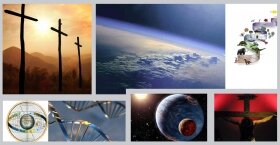
- (left) Abraham was commanded by God to offer his son up as a sacrifice in the land of Moriah. Proceeding to obey, he was prevented by an angel as he was about to sacrifice his son, and slew a ram which he found on the spot.
- (right) God offered His son, Jesus, as a sacrifice for all mankind
(John 3:16). (larger image) The word faith has various uses; its central meaning is similar to "belief", "trust" or "confidence", but unlike these terms, "faith" tends to imply transcending the personal rather than an interpersonal relationship – with God. The object of faith can be a person (or even an inanimate object or state of affairs) or a proposition (or body of propositions, such as a religious credo). In each case, however, faith is in an aspect of the object and cannot be logically proven or objectively known. Faith can also be defined as accepting as true something which one has been told by someone who is believed to be trustworthy. In its proper sense faith means trusting the word of another. Religious Faith In religious contexts, "faith" has several different meanings. Sometimes, it means loyalty to one's religion. It is in this sense in which one can speak of, for example, "the Catholic faith" or "the Islamic faith." For denominational or doctrinal religions, faith also means that one accepts the religious tenets of the religion as true. For non-doctrinal or creed-oriented religions, often means that one is loyal to a particular religious community. In general, faith means being sure of what you hope for and certain of what you do not see with your physical (as opposed to spiritual) eyes. In Romans 8:24-28 of the King James Version of the Christian Bible, an intriguing, and perhaps controversial contradiction to the general interpretation that "faith means being sure of what you hope for.." is found. 24-For we are saved by hope: but hope that is seen is not hope: for what a man seeth, why doth he yet hope for? 25-But if we hope for that we see not, then do we with patience wait for it. 26-Likewise the Spirit also helpeth our infirmities: for we know not what we should pray for as we ought: but the Spirit itself maketh intercession for us with groanings which cannot be uttered. 27-And he that searcheth the hearts knoweth what is the mind of the Spirit, because he maketh intercession for the saints according to the will of God. 28-And we know that all things work together for good to them that love God, to them who are the called according to his purpose. The biblical text is replete with implications for faith as well as hope. Yet, not even a conceptual grasp of God is admitted. The hopeful are enjoined to wait patiently, to experience the presence of God, only as groanings which can not be uttered. Perhaps depicted is the transcension of hope into faith, where the object of faith is not what is seen with spiritual eyes, but is more, as in the reference to "he that searcheth the hearts knoweth" that which is realized as the transformation of human intent. Underling reference to the mind of the spirit is arguably that higher purpose of the saints, a purpose which transcends the Salvation of the self. Here then is relief of our human infirmities: a hope for the Salvation of mankind, achievable only by those who discover their purpose, here presented ultimately, not as faith in, but love of God - that God which is revealed as each according to his purpose, work together for good. Sometimes, faith means a belief in a relationship with a deity. In this case, "faith" is used in the sense of "fidelity." Such a commitment need not be blind or submissive, although it often shares these types of characteristics. For many Jews, for example, the Hebrew Bible and Talmud depict a committed but contentious relationship between their God and the Children of Israel. For quite a lot of people, faith or the lack thereof, is an important part of their identities. E.g. a person will identify him or herself as a Muslim or a skeptic. Many religious rationalists, as well as non-religious people, criticize implicit faith as being irrational. In this view, belief should be restricted to what is directly supportable by logic or evidence and nothing should be believed unless supported by the Scientific method. Others say faith is perfectly compatible with and does not necessary contradict reason. Sometimes faith can be referred as ignorance of reality. It is a strong belief in something with no proof. Sometimes, faith means a belief in the existence of a deity, and can be used to distinguish individual belief in deities from belief in deities within religion. However it can also be used in context of belief in deities within religions. Many Jews, Christians and Muslims claim that there is adequate historical evidence of their God's existence and interaction with human beings. As such, they may believe that there is no need for "faith" in God in the sense of belief against or despite evidence; rather, they hold that evidence is sufficient to demonstrate that their God certainly exists, and that particular beliefs, concerning who or what their God is and why this God is to be trusted, are vindicated by evidence and logic. There is no historical evidence, which convinces the whole community of historians that any one religion is true. For people in this category, "faith" in a God simply means "belief that one has knowledge of [any particular] God". It is logically impossible that all these different religions with their mutually contradictory beliefs can simultaneously be true. Therefore the majority of believers have faith in a belief system which is in some ways false, which they have difficulty describing at least. This is disputed though by some religious traditions especially in Hinduism who hold the view that the several different faiths are just aspects of the ultimate truth that the several religions have difficulty to describe and understand. They see the different religions as just different paths to the same goal. This does not explain away all logical contradictions between faiths but these traditions say that all seeming contradictions will be understood once a person has an experience of the Hindu concept of moksha. What is believed concerning God, in this sense, is at least in principle only as reliable as the evidence and the logic by which faith is supported. Finally, some religious believers – and many of their critics – often use the term "faith" as the affirmation of belief without an ongoing test of evidence, and even despite evidence apparently to the contrary. Most Jews, Christians and Muslims admit that whatever particular evidence or reason they may possess that their God exists and is deserving of trust, is not ultimately the basis for their believing. Thus, in this sense faith refers to belief beyond evidence or logical arguments, sometimes called "implicit faith". Another form of this kind of faith is fideism: one ought to believe that God exists, but one should not base that belief on any other beliefs; one should, instead, accept it without any reasons at all. Faith in this sense, grounded simply in the sincerity of faith, belief on the basis of believing, is often associated with Søren Kierkegaard for example, and some other existentialist religious thinkers; his views are presented in Fear and Trembling. William Sloane Coffin counters that faith is not acceptance without proof, but trust without reservation. Judaism Although Judaism does recognize the positive value of Emunah (faith/belief) and the negative status of the Apikorus (heretic) the specific tenets that compose required belief and their application to the times have been heatedly disputed throughout Jewish history. Many, but not all, Orthodox Jews have accepted Maimonides' Thirteen Principles of Belief. For a wide history of this dispute, see: Shapira, Marc: The Limits of Orthodox Theology: Maimonides' Thirteen Principles Reappraised (Littman Library of Jewish Civilization (Series).) Christianity Faith in Christianity centers on faith in the saving grace of Christ the Son of the living God, who died for the sin of the world. The precise meaning and content of faith in Christianity differs somewhat between the various Christian traditions. The definition of this quality for Christians is found in the scriptural text at Hebrews 11:1: "Now faith is being sure of what we hope for and certain of what we do not see". Faith in Christianity, as in other Abrahamic religions, centers on a belief in God, a belief in the reality of a transcendent domain that God administers as his kingdom, and in the benevolence of God's will or plan for humankind. Christianity differs in that it centers on a belief in the ministry of Jesus, and in his place as the prophesied Christ, as substantiated by his Passion and Resurrection. The precise understanding of the term "faith" differs among the various Christian traditions, but this verse is often used as a standard statement of Christian faith: "For God so loved the world, that he gave his only begotten Son, that whosoever believeth in him should not perish, but have everlasting life." (John 3:16, KJV) Belief in the Resurrection According to most Christian traditions, Christian faith requires a belief in Jesus' resurrection from the dead. The truth of the resurrection is substantiated in several ways: (1 Corinthians 15:1-4) '.. the gospel I preached to you.. Otherwise, you have believed in vain..'. The same book says, in 15:14: "And if Christ has not been raised, our preaching is useless and so is your faith" (see also Acts 2:32; Philippians 3:10; John 11:25). That he was raised from the death for God the Father. Most Christians believe that God is one eternal being who exists as three distinct, eternal, and indivisible persons: the Father, the Son (Jesus Christ the eternal Word), and the Holy Spirit. New Testament The word "faith", translated from the Greek πιστις (pi'stis), was primarily used in the New Testament with the Greek perfect tense and translates as a noun-verb hybrid; which is not adequately conveyed by the English noun. Pi'stis in the New Testament context is a physical action, based upon a mental belief and sustained with confidence. Belief, in this context is non-synonymous with faith because, belief primarily conveys the mental action, thought of confidence, trust, and/or firm persuasion, not the physical act. Depending on the context, the Greek word may also be understood to mean "faithfulness" or "fidelity" (cf. 1 Thess 3:7; Titus 2:10); indeed, Karl Barth consistently translates "pistis" as "the faithfulness of God" in his commentary Epistle to the Romans. Commenting on the function of faith in relation to the covenant of God, the writer of the Epistle to the Hebrews says, "Now faith is the assurance of things hoped for, the conviction of things not seen" (Heb 11:1 ESV). ὑπόστασις hypostasis (hy-po'sta-sis), translated: - a setting or placing under
- thing put under, substructure, foundation
- that which has foundation, is firm
- that which has actual existence
- the substantial quality, nature, of a person or thing
- the steadfastness of mind, firmness, courage, resolution
- confidence, firm trust, assurance
here, commonly appears in ancient papyrus business documents, conveying the idea that a covenant is an exchange of assurances which guarantees the future transfer of possessions described in the contract. In view of this, Moulton and Milligan suggest the rendering: "Faith is the title deed of things hoped for" (Vocabulary of the Greek Testament, 1963, p. 660). The Greek word e´leg-khos, rendered "conviction" at Hebrews 11:1 (ESV), conveys the idea of bringing forth evidence that demonstrates something, particularly something contrary to what appears to be the case. Thereby this evidence makes clear what has not been discerned before and so refutes what has only appeared to be the case. This evidence for conviction is so positive or powerful that faith is said to be it. Christian faith, described in these terms, is not synonymous with credulity. Hebrews 11:6 describes the meaning and the practical role of faith: "Without faith it is impossible to please [God], for he who comes to God must believe that He is, and that He is a rewarder of those who diligently seek Him." Summarizing the New Testament concept of faith, it is reliance upon God's self-revelation, especially in the sense of confidence in the promises and fear of the threats that are written in Scripture. The writers evidently suppose that their concept of faith is rooted in the Hebrew Scriptures. In addition, the New Testament writers equate faith in God with belief in Jesus Christ. For example, the Gospel of John quotes Jesus as saying, "The Father judges no one, but has given all judgment to the Son, that all may honor the Son, just as they honor the Father. Whoever does not honor the Son does not honor the Father who sent him" (John 5:22–23). When asked "What must we do to do the works God requires?" the writer has Jesus answering, "The work of God is this: to believe (pi'stis) in the one he has sent" (John 6:28–29). Roman Catholicism Relief of allegory of Faith on the Holy Trinity Column in Olomouc According to Roman Catholic theology, in an objective sense faith is the sum of truths revealed by God in Scripture and tradition and which the Church presents to us in a brief form in its creeds. Subjectively, faith stands for the habit or virtue by which these truths are assented to. Faith is a supernatural act Faith is claimed to be a supernatural act performed by Divine grace. It is "the act of the intellect assenting to a Divine truth owing to the movement of the will, which is itself moved by the grace of God" (St. Thomas, II-II, Q. iv, a. 2). And just as the light of faith is a gift supernaturally bestowed upon the understanding, so also this Divine grace moving the will is, as its name implies, an equally supernatural and an absolutely gratuitous gift. Neither gift is due to previous study, neither of them can be acquired by human efforts, but "Ask and ye shall receive." Because the virtue is "infused" and not reachable by human efforts, it is therefore one of the theological virtues. Faith is not blind "We believe", says the Vatican Council (III, iii), "that revelation is true, not indeed because the intrinsic truth of the mysteries is clearly seen by the natural light of reason, but because of the authority of God Who reveals them, for He can neither deceive nor be deceived." Thus, with regard to the act of faith which the Christian makes in the Holy Trinity, faith can be described in a syllogistic fashion, thus: - Whatever God reveals is true
- but, God has revealed the Holy Trinity, which is a mystery
- therefore this mystery is true.
Roman Catholics accept the major premise as being beyond doubt, a presupposition upon which reason is based and thus intrinsically evident to reason; the minor premise is also held to be true, based on belief in the infallibility of certain Church declarations, and also because, as the Vatican Council says, "in addition to the internal assistance of His Holy Spirit, it has pleased God to give us certain external proofs of His revelation, viz. certain Divine facts, especially miracles and prophecies, for since these latter clearly manifest God's omnipotence and infinite knowledge, they afford most certain proofs of His revelation and are suited to the capacity of all." Hence Thomas Aquinas writes: "A man would not believe unless he saw the things he had to believe, either by the evidence of miracles or of something similar" (II-II:1:4, ad 1). Thomas is here speaking of the motives of credibility, the causes which give rise to belief. Text adapted from The Catholic Encyclopedia article "Faith". Eastern Christianity Noetic faculty Faith (pistis) in Eastern Christianity is an activity of the nous or spirit. Faith being characteristic of the noesis or noetic experience of the nous or spirit. Faith here being defined as intuitive truth meaning as a gift from God, faith is one of God's uncreated energies (Grace too is another of God's uncreated energies and gifts). The God in Trinity is uncreated or incomprehensible in nature, being or essence. Therefore in Eastern Christianity, unlike in Western Christianity (see Actus et potentia), God's essence or incomprehisiblity is distinguished from his uncreated energies. This is clarified in the Essence-Energies distinction of Gregory Palamas. Faith here beyond simply a belief in something. Faith here as an activity or operation of God working in and through mankind. Faith being a critical aspect to the relationship between man and the God, this relationship or process is called Theosis. Faith as an operation in contemplating of an object for understanding. Mankind's analysis of an objects properties: enables us to form concepts. But this analysis can in no case exhaust the content of the object of perception. There will always remain an "irrational residue" which escapes analysis and which can not be expressed in concepts: it is this unknowable depth of things, that which constitutes their true, indefinable essence that also reflects the origin of things in God. Intuitive truth As God in Trinity, as the anomalies of God's essence or being. In Eastern Christianity it is by faith or intuitive truth that this component of an objects existence is grasp. Though God through his energies draws us to him, his essence remains inaccessible. The operation of faith being the means of free will by which mankind faces the future or unknown, these noetic operations contained in the concept of insight or noesis.XIV. SAVING FAITH. Lutheranism According to Lutherans, saving faith is the knowledge of, acceptance of , and trust in the promise of the Gospel. Protestantism Main Article: Protestantism Faith as steadfastness in reasoned belief Protestant Christian C.S. Lewis described his experience of faith in his book Mere Christianity by distinguishing between two usages of the word. He describes the first as follows: "Faith seems to be used by Christians in two senses or on two levels .. In the first sense it means simply Belief." Several paragraphs later he continues with: "Faith, in the sense in which I am here using the word, is the art of holding on to things your reason has once accepted, in spite of your changing moods." Faith involving knowledge Protestants differ on the exact relationship between faith and knowledge, although all agree that knowledge is normally involved. Roughly, the split is between paedobaptists and baptists, with paedobaptists asserting that faith means placing one's trust in Jesus Christ according to the measure of understanding granted, and baptists asserting faith means placing one's trust in Jesus Christ with a certain minimal core of understanding being necessary. Faith is an operation of the Spirit of God Assent to the truth is of the essence of faith, and the ultimate ground on which our assent to any revealed truth rests is the veracity of God. Historical faith is the apprehension of and assent to certain statements which are regarded as mere facts of history. Temporary faith is that state of mind which is awakened in men (e.g., Felix) by the exhibition of the truth and by the influence of religious sympathy, or by what is sometimes styled the common operation of the Holy Spirit. Saving faith is so called because it has eternal life inseparably connected with it, and is a special operation of the Holy Spirit. Faith as a gift of God Paul writes in Ephesians 2:8-9 "For it is by grace you have been saved, through faith, and that not of yourselves; it is the gift of God, not of works lest anyone should boast." From this, some Protestants believe that faith itself is given as a gift of God (e.g. the Westminster Confession of Faith), although this interpretation is disputed by others. The Calvinistic View of Faith: [Saving] Faith, itself, is a gift from God. The Arminian View of Faith: Faith is not a Gift of God but Salvation is. Hebrews 11:6 And without faith it is impossible to please God, because anyone who comes to him must believe that he exists and that he rewards those who earnestly seek him. So to say faith is a gift would be "Without the Gift of God" it is impossible to please God and to receive this gift through seeking Him with the gift he would give you. Salvation is the Gift. New Testament The word "faith", translated from the Greek πιστις (pi´stis), primarily conveys the thought of confidence, trust, firm persuasion. Depending on the context, the Greek word may also be understood to mean "faithfulness" or "fidelity".-1Th 3:7; Tit 2:10. Commenting on the function of faith in relation to the covenant of God, the writer of the Epistle to the Hebrews says, "Now faith is the assurance of things hoped for, the conviction of things not seen."(Heb 11:1). Υποστασις (hy-po´sta-sis), translated "assurance" here, commonly appears in ancient papyrus business documents, conveying the idea that a covenant is an exchange of assurances which guarantees the future transfer of possessions described in the contract. In view of this, Moulton and Milligan suggest the rendering: "Faith is the title deed of things hoped for." (Vocabulary of the Greek Testament, 1963, p. 660) The Greek word e´leg-khos, rendered "conviction" at Hebrews 11:1 (ESV), conveys the idea of bringing forth evidence that demonstrates something, particularly something contrary to what appears to be the case. Thereby this evidence makes clear what has not been discerned before and so refutes what has only appeared to be the case. This evidence for conviction is so positive or powerful that faith is said to be it. Christian faith, described in these terms, is not synonymous with credulity. Hebrews 11:6 describes the meaning and the practical role of faith: "Without faith it is impossible to please [God], for he who comes to God must believe that He is, and that He is a rewarder of those who diligently seek Him.". Summarizing the New Testament concept of faith, it is a reliance upon God's self-revelation, especially in the sense of confidence in the promises and fear of the threats that are written in Scripture. The writers evidently suppose that their concept of faith is rooted in the Hebrew Scriptures. In addition, the New Testament writers conflate or equate faith in God with belief in Jesus Christ. The Gospel of John is particularly emphatic on this point, having Jesus say, "The Father judges no one, but has given all judgment to the Son, that all may honor the Son, just as they honor the Father. Whoever does not honor the Son does not honor the Father who sent him." (John 5:22, 23). When asked "What must we do to do the works God requires?", the writer has Jesus answering, "The work of God is this: to believe in the one he has sent." (John 6:28, 29) Faith is a supernatural act Faith is a supernatural act performed by Divine grace. It is "the act of the intellect assenting to a Divine truth owing to the movement of the will, which is itself moved by the grace of God" (St. Thomas, II-II, Q. iv, a. 2). And just as the light of faith is a gift supernaturally bestowed upon the understanding, so also this Divine grace moving the will is, as its name implies, an equally supernatural and an absolutely gratuitous gift. Neither gift is due to previous study neither of them can be acquired by human efforts, but "Ask and ye shall receive." Faith not blind "We believe", says the Vatican Council (III, iii), "that revelation is true, not indeed because the intrinsic truth of the mysteries is clearly seen by the natural light of reason, but because of the authority of God Who reveals them, for He can neither deceive nor be deceived." Thus, with regard to the act of faith which the Christian makes in the Holy Trinity, faith can be described in a syllogistic fashion, thus: Whatever God reveals is true but, God has revealed the Holy Trinity, which is a mystery therefore this mystery is true. Roman Catholics accept the major premise as being beyond doubt, a presupposition upon which reason is based and thus intrinsically evident to reason; the minor premise is also true because it is declared by the Church, which is held to be infallible in its declarations, and also because, as the Vatican Council says, "in addition to the internal assistance of His Holy Spirit, it has pleased God to give us certain external proofs of His revelation, viz. certain Divine facts, especially miracles and prophecies, for since these latter clearly manifest God's omnipotence and infinite knowledge, they afford most certain proofs of His revelation and are suited to the capacity of all." Hence Thomas Aquinas writes: "A man would not believe unless he saw the things he had to believe, either by the evidence of miracles or of something similar" (II-II:1:4, ad 1). Thomas is here speaking of the motives of credibility, the causes which give rise to belief. Protestantism Faith is a kind of knowledge Knowledge is an essential element in all faith, and is sometimes spoken of as an equivalent to faith (John 10:38; 1 John 2:3). Yet the two are distinguished in this respect, that faith includes in it assent, which is an act of the will in addition to the act of the understanding. Faith is an operation of the Spirit of God Assent to the truth is of the essence of faith, and the ultimate ground on which our assent to any revealed truth rests is the veracity of God. Historical faith is the apprehension of and assent to certain statements which are regarded as mere facts of history. Temporary faith is that state of mind which is awakened in men (e.g., Felix) by the exhibition of the truth and by the influence of religious sympathy, or by what is sometimes styled the common operation of the Holy Spirit. Saving faith is so called because it has eternal life inseparably connected with it, and is a special operation of the Holy Spirit. The warrant of faith is the truthfulness of God The basis for faith is Divine testimony, not the reasonableness of what God says, but the simple fact that he says it. Faith rests immediately on, "Thus saith the Lord." But in order to this faith the veracity, sincerity, and truth of God must be owned and appreciated, together with his unchangeableness. Faith in the Bible The word faith occurs 278 times in 257 verses in the ESV Old Testament Torah - Exodus 21:8 "If she does not please her master, who has designated her* for himself, then he shall let her be redeemed. He shall have no right to sell her to a foreign people, since he has broken faith with her.
- Leviticus 5:15 "If anyone commits a breach of faith and sins unintentionally in any of the Holy things of the Lord , he shall bring to the Lord as his compensation, a ram without blemish out of the flock, valued* in silver shekels,* according to the shekel of the sanctuary, for a guilt offering.
- Leviticus 6:2 "If anyone sins and commits a breach of faith against the Lord by deceiving his neighbor in a matter of deposit or security, or through robbery, or if he has oppressed his neighbor
- Numbers 5:6 "Speak to the people of Israel, When a man or woman commits any of the sins that people commit by breaking faith with the Lord , and that person realizes his guilt,
- Numbers 5:12 "Speak to the people of Israel, If any man's wife goes astray and breaks faith with him,
- Numbers 5:27 "And when he has made her drink the water, then, if she has defiled herself and has broken faith with her husband, the water that brings the curse shall enter into her and cause bitter pain, and her womb shall swell, and her thigh shall fall away, and the woman shall become a curse among her people.
- Deuteronomy 32:51 "because you broke faith with me in the midst of the people of Israel at the waters of Meribah-kadesh, in the wilderness of Zin, and because you did not treat me as Holy in the midst of the people of Israel.
Nevi'im or Prophets - Joshua 7:1 But the people of Israel broke faith in regard to the devoted things, for Achan the son of Carmi, son of Zabdi, son of Zerah, of the tribe of Judah, took some of the devoted things. And the anger of the Lord burned against the people of Israel.
- Joshua 22:16 "Thus says the whole congregation of the Lord , 'What is this breach of faith that you have committed against the God of Israel in turning away this day f
- Romans following the Lord by building yourselves an altar this day in rebellion against the Lord ?
- Joshua 22:20 "'Did not Achan the son of Zerah break faith in the matter of the devoted things, and wrath fell upon all the congregation of Israel? And he did not perish alone for his iniquity.'"
- Joshua 22:22 "The Mighty One, God, the Lord ! The Mighty One, God, the Lord ! He knows; and let Israel itself know! If it was in rebellion or in breach of faith against the Lord , do not spare us today
- Joshua 22:31 And Phinehas the son of Eleazar the priest said to the people of Reuben and the people of Gad and the people of Manasseh, "Today we know that the Lord is in our midst, because you have not committed this breach of faith against the Lord . Now you have delivered the people of Israel f
- Romans the hand of the Lord ."
- Judges 9:15 "And the bramble said to the trees, 'If in good faith you are anointing me king over you, then come and take refuge in my shade, but if not, let fire come out of the bramble and devour the cedars of Lebanon.'
- Judges 9:16 "Now therefore, if you acted in good faith and integrity when you made Abimelech king, and if you have dealt well with Jerubbaal and his house and have done to him as his deeds deserved--
- Judges 9:19 "if you then have acted in good faith and integrity with Jerubbaal and with his house this day, then rejoice in Abimelech, and let him also rejoice in you.
- 1 Chronicles 2:7 The son* of Carmi: Achan, the troubler of Israel, who broke faith in the matter of the devoted thing;
- 1 Chronicles 5:25 But they broke faith with the God of their fathers, and whored after the gods of the peoples of the land, whom God had destroyed before them.
- 1 Chronicles 9:1 So all Israel was recorded in genealogies, and these are written in the Book of the Kings of Israel. And Judah was taken into exile in Babylon because of their breach of faith.
- 1 Chronicles 10:13 So Saul died for his breach of faith. He broke faith with the Lord in that he did not keep the command of the Lord , and also consulted a medium, seeking guidance.
- Ezra 10:2 And Shecaniah the son of Jehiel, of the sons of Elam, addressed Ezra: "We have broken faith with our God and have married foreign women f
- Romans the peoples of the land, but even now there is hope for Israel in spite of this.
- Ezra 10:10 And Ezra the priest stood up and said to them, "You have broken faith and married foreign women, and so increased the guilt of Israel.
Wisdom books - Job 39:12 "Do you have faith in him that he will return your grain and gather it to your threshing floor?
- Psalms 106:24 Then they despised the pleasant land, having no faith in his promise.
- Psalms 146:6 who made heaven and earth, the sea, and all that is in them, who keeps faith forever;
Major Prophets Isaiah 7:9 "'And the head of Ephraim is Samaria, and the head of Samaria is the son of Remaliah. If you* are not firm in faith, you will not be firm at all.'" Isaiah 26:2 "Open the gates, that the righteous nation that keeps faith may enter in. Minor Prophets - Habakkuk 2:4 "Behold, his soul is puffed up; it is not upright within him, but the righteous shall live by his faith.*
The Gospels - Matthew 6:30 "But if God so clothes the grass of the field, which today is alive and tomorrow is thrown into the oven, will he not much more clothe you, O you of little faith?
- Matthew 8:10 When Jesus heard this, he marveled and said to those who followed him, "Truly, I tell you, with no one in Israel* have I found such faith.
- Matthew 8:26 And he said to them, "Why are you afraid, O you of little faith?" Then he rose and rebuked the winds and the sea, and there was a great calm.
- Matthew 9:2 And behold, some people brought to him a paralytic, lying on a bed. And when Jesus saw their faith, he said to the paralytic, "Take heart, my son; your sins are forgiven."
- Matthew 9:22 Jesus turned, and seeing her he said, "Take heart, daughter; your faith has made you well." And instantly* the woman was made well.
- Matthew 9:29 Then he touched their eyes, saying, "According to your faith be it done to you."
- Matthew 14:31 Jesus immediately reached out his hand and took hold of him, saying to him, "O you of little faith, why did you doubt?"
- Matthew 15:28 Then Jesus answered her, "O woman, great is your faith! Be it done for you as you desire." And her daughter was healed instantly.*
- Matthew 16:8 But Jesus, aware of this, said, "O you of little faith, why are you discussing among yourselves the fact that you have no bread?
- Matthew 17:20 He said to them, "Because of your little faith. For truly, I say to you, if you have faith like a grain of mustard seed, you will say to this mountain, 'Move f
- Romans here to there,' and it will move, and nothing will be impossible for you."*
- Matthew 21:21 And Jesus answered them, "Truly, I say to you, if you have faith and do not doubt, you will not only do what has been done to the fig tree, but even if you say to this mountain, 'Be taken up and thrown into the sea,' it will happen.
- Matthew 21:22 "And whatever you ask in prayer, you will receive, if you have faith."
- Mark 2:5 And when Jesus saw their faith, he said to the paralytic, "My son, your sins are forgiven."
- Mark 4:40 He said to them, "Why are you so afraid? Have you still no faith?"
- Mark 5:34 And he said to her, "Daughter, your faith has made you well; go in peace, and be healed of your disease."
- Mark 10:52 And Jesus said to him, "Go your way; your faith has made you well." And immediately he recovered his sight and followed him on the way.
- Mark 11:22 And Jesus answered them, "Have faith in God.
- Luke 5:20 And when he saw their faith, he said, "Man, your sins are forgiven you."
- Luke 7:9 When Jesus heard these things, he marveled at him, and turning to the crowd that followed him, said, "I tell you, not even in Israel have I found such faith."
- Luke 7:50 And he said to the woman, "Your faith has saved you; go in peace."
- Luke 8:25 He said to them, "Where is your faith?" And they were afraid, and they marveled, saying to one another, "Who then is this, that he commands even winds and water, and they obey him?"
- Luke 8:48 And he said to her, "Daughter, your faith has made you well; go in peace."
- Luke 12:28 "But if God so clothes the grass, which is alive in the field today, and tomorrow is thrown into the oven, how much more will he clothe you, O you of little faith!
- Luke 17:5 The apostles said to the Lord, "Increase our faith!"
- Luke 17:6 And the Lord said, "If you had faith like a grain of mustard seed, you could say to this mulberry tree, 'Be uprooted and planted in the sea,' and it would obey you.
- Luke 17:19 And he said to him, "Rise and go your way; your faith has made you well."*
- Luke 18:8 "I tell you, he will give justice to them speedily. Nevertheless, when the Son of Man comes, will he find faith on earth?"
- Luke 18:42 And Jesus said to him, "Recover your sight; your faith has made you well."
- Luke 22:32 "but I have prayed for you that your faith may not fail. And when you have turned again, strengthen your brothers."
The History - Acts 3:16 "And his name--by faith in his name--has made this man strong whom you see and know, and the faith that is through Jesus* has given the man this perfect health in the presence of you all.
- Acts 6:5 And what they said pleased the whole gathering, and they chose Stephen, a man full of faith and of the Holy Spirit, and Philip, and Prochorus, and Nicanor, and Timon, and Parmenas, and Nicolaus, a proselyte of Antioch.
- Acts 6:7 And the word of God continued to increase, and the number of the disciples multiplied greatly in Jerusalem, and a great many of the priests became obedient to the faith.
- Acts 11:24 for he was a good man, full of the Holy Spirit and of faith. And a great many people were added to the Lord.
- Acts 13:8 But Elymas the magician (for that is the meaning of his name) opposed them, seeking to turn the proconsul away f
- Romans the faith.
- Acts 14:9 He listened to Paul speaking. And Paul, looking intently at him and seeing that he had faith to be made well,*
- Acts 14:22 strengthening the souls of the disciples, encouraging them to continue in the faith, and saying that through many tribulations we must enter the kingdom of God.
- Acts 14:27 And when they arrived and gathered the church together, they declared all that God had done with them, and how he had opened a door of faith to the Gentiles.
- Acts 15:9 "and he made no distinction between us and them, having cleansed their hearts by faith.
- Acts 16:5 So the churches were strengthened in the faith, and they increased in numbers daily.
- Acts 20:21 "testifying both to Jews and to Greeks of repentance toward God and of faith in our Lord Jesus Christ.
- Acts 24:24 After some days Felix came with his wife Drusilla, who was Jewish, and he sent for Paul and heard him speak about faith in Christ Jesus.
- Acts 26:18 "'to open their eyes, so that they may turn f
- Romans darkness to light and f
- Romans the power of Satan to God, that they may receive forgiveness of sins and a place among those who are sanctified by faith in me.'
- Acts 27:25 "So take heart, men, for I have faith in God that it will be exactly as I have been told.
The Pauline Epistles - Romans 1:5 through whom we have received grace and apostleship to bring about the obedience of faith for the sake of his name among all the nations,
- Romans 1:8 First, I thank my God through Jesus Christ for all of you, because your faith is proclaimed in all the world.
- Romans 1:12 that is, that we may be mutually encouraged by each other's faith, both yours and mine.
- Romans 1:17 For in it the righteousness of God is revealed f
- Romans faith for faith,* as it is written, "The righteous shall live by faith."*
- Romans 3:22 the righteousness of God through faith in Jesus Christ for all who believe. For there is no distinction:
- Romans 3:25 whom God put forward as a propitiation by his blood, to be received by faith. This was to show God's righteousness, because in his Divine forbearance he had passed over former sins.
- Romans 3:26 It was to show his righteousness at the present time, so that he might be just and the justifier of the one who has faith in Jesus.
- Romans 3:27 Then what becomes of our boasting? It is excluded. By what kind of law? By a law of works? No, but by the law of faith.
- Romans 3:28 For we hold that one is justified by faith apart f
- Romans works of the law.
- Romans 3:30 since God is one. He will justify the circumcised by faith and the uncircumcised through faith.
- Romans 3:31 Do we then overthrow the law by this faith? By no means! On the contrary, we uphold the law.
- Romans 4:5 And to the one who does not work but trusts him who justifies the ungodly, his faith is counted as righteousness,
- Romans 4:9 Is this blessing then only for the circumcised, or also for the uncircumcised? We say that faith was counted to Abraham as righteousness.
- Romans 4:11 He received the sign of circumcision as a seal of the righteousness that he had by faith while he was still uncircumcised. The purpose was to make him the father of all who believe without being circumcised, so that righteousness would be counted to them as well,
- Romans 4:12 and to make him the father of the circumcised who are not merely circumcised but who also walk in the footsteps of the faith that our father Abraham had before he was circumcised.
- Romans 4:13 For the promise to Abraham and his offspring that he would be heir of the world did not come through the law but through the righteousness of faith.
- Romans 4:14 For if it is the adherents of the law who are to be the heirs, faith is null and the promise is void.
- Romans 4:16 That is why it depends on faith, in order that the promise may rest on grace and be guaranteed to all his offspring--not only to the adherent of the law but also to the one who shares the faith of Abraham, who is the father of us all,
- Romans 4:19 He did not weaken in faith when he considered his own body, which was as good as dead (since he was about a hundred years old), or when he considered the barrenness of Sarah's womb.
- Romans 4:20 No distrust made him waver concerning the promise of God, but he grew strong in his faith as he gave glory to God,
- Romans 4:22 That is why his faith was "counted to him as righteousness."
- Romans 5:1 Therefore, since we have been justified by faith, we* have peace with God through our Lord Jesus Christ.
- Romans 5:2 Through him we have also obtained access by faith* into this grace in which we stand, and we* rejoice* in hope of the glory of God.
- Romans 9:30 What shall we say, then? That Gentiles who did not pursue righteousness have attained it, that is, a righteousness that is by faith;
- Romans 9:32 Why? Because they did not pursue it by faith, but as if it were based on works. They have stumbled over the stumbling stone,
- Romans 10:6 But the righteousness based on faith says, "Do not say in your heart, 'Who will ascend into heaven?'" (that is, to bring Christ down)
- Romans 10:8 But what does it say? "The word is near you, in your mouth and in your heart" (that is, the word of faith that we proclaim);
- Romans 10:17 So faith comes f
- Romans hearing, and hearing through the word of Christ.
- Romans 11:20 That is true. They were broken off because of their unbelief, but you stand fast through faith. So do not become proud, but stand in awe.
- Romans 12:3 For by the grace given to me I say to everyone among you not to think of himself more highly than he ought to think, but to think with sober judgment, each according to the measure of faith that God has assigned.
- Romans 12:6 Having gifts that differ according to the grace given to us, let us use them: if prophecy, in proportion to our faith;
- Romans 14:1 As for the one who is weak in faith, welcome him, but not to quarrel over opinions.
- Romans 14:22 The faith that you have, keep between yourself and God. Blessed is the one who has no reason to pass judgment on himself for what he approves.
- Romans 14:23 But whoever has doubts is condemned if he eats, because the eating is not f
- Romans faith. For whatever does not proceed f
- Romans faith is sin.*
- Romans 16:26 but has now been disclosed and through the prophetic writings has been made known to all nations, according to the command of the eternal God, to bring about the obedience of faith--
- 1 Corinthians 2:5 that your faith might not rest in the wisdom of men but in the power of God.
- 1 Corinthians 12:9 to another faith by the same Spirit, to another gifts of healing by the one Spirit,
- 1 Corinthians 13:2 And if I have prophetic powers, and understand all mysteries and all knowledge, and if I have all faith, so as to remove mountains, but have not love, I am nothing.
- 1 Corinthians 13:13 So now faith, hope, and love abide, these three; but the greatest of these is love.
- 1 Corinthians 15:14 And if Christ has not been raised, then our preaching is in vain and your faith is in vain.
- 1 Corinthians 15:17 And if Christ has not been raised, your faith is futile and you are still in your sins.
- 1 Corinthians 16:13 Be watchful, stand firm in the faith, act like men, be strong.
- 2 Corinthians 1:24 Not that we lord it over your faith, but we work with you for your joy, for you stand firm in your faith.
- 2 Corinthians 4:13 Since we have the same spirit of faith according to what has been written, "I believed, and so I spoke," we also believe, and so we also speak,
- 2 Corinthians 5:7 for we walk by faith, not by sight.
- 2 Corinthians 8:7 But as you excel in everything--in faith, in speech, in knowledge, in all earnestness, and in our love for you*--see that you excel in this act of grace also.
- 2 Corinthians 10:15 We do not boast beyond limit in the labors of others. But our hope is that as your faith increases, our area of influence among you may be greatly enlarged,
- 2 Corinthians 13:5 Examine yourselves, to see whether you are in the faith. Test yourselves. Or do you not realize this about yourselves, that Jesus Christ is in you?--unless indeed you fail to meet the test!
- Galatians 1:23 They only were hearing it said, "He who used to persecute us is now preaching the faith he once tried to destroy."
- Galatians 2:16 yet we know that a person is not justified* by works of the law but through faith in Jesus Christ,* so we also have believed in Christ Jesus, in order to be justified by faith in Christ and not by works of the law, because by works of the law no one will be justified.
- Galatians 2:20 I have been crucified with Christ. It is no longer I who live, but Christ who lives in me. And the life I now live in the flesh I live by faith in the Son of God, who loved me and gave himself for me.
- Galatians 3:2 Let me ask you only this: Did you receive the Spirit by works of the law or by hearing with faith?
- Galatians 3:5 Does he who supplies the Spirit to you and works miracles among you do so by works of the law, or by hearing with faith--
- Galatians 3:7 Know then that it is those of faith who are the sons of Abraham.
- Galatians 3:8 And the Scripture, foreseeing that God would justify* the Gentiles by faith, preached the gospel beforehand to Abraham, saying, "In you shall all the nations be blessed."
- Galatians 3:9 So then, those who are of faith are blessed along with Abraham, the man of faith.
- Galatians 3:11 Now it is evident that no one is justified before God by the law, for "The righteous shall live by faith."*
- Galatians 3:12 But the law is not of faith, rather "The one who does them shall live by them."
- Galatians 3:14 so that in Christ Jesus the blessing of Abraham might come to the Gentiles, so that we might receive the promised Spirit through faith.
- Galatians 3:22 But the Scripture imprisoned everything under sin, so that the promise by faith in Jesus Christ might be given to those who believe.
- Galatians 3:23 Now before faith came, we were held captive under the law, imprisoned until the coming faith would be revealed.
- Galatians 3:24 So then, the law was our guardian until Christ came, in order that we might be justified by faith.
- Galatians 3:25 But now that faith has come, we are no longer under a guardian,
- Galatians 3:26 for in Christ Jesus you are all sons of God, through faith.
- Galatians 5:5 For through the Spirit, by faith, we ourselves eagerly wait for the hope of righteousness.
- Galatians 5:6 For in Christ Jesus neither circumcision nor uncircumcision counts for anything, but only faith working through love.
- Galatians 6:10 So then, as we have opportunity, let us do good to everyone, and especially to those who are of the household of faith.
- Ephesians 1:15 For this reason, because I have heard of your faith in the Lord Jesus and your love* toward all the saints,
- Ephesians 2:8 For by grace you have been saved through faith. And this is not your own doing; it is the gift of God,
- Ephesians 3:12 in whom we have boldness and access with confidence through our faith in him.
- Ephesians 3:17 so that Christ may dwell in your hearts through faith--that you, being rooted and grounded in love,
- Ephesians 4:5 one Lord, one faith, one baptism,
- Ephesians 4:13 until we all attain to the unity of the faith and of the knowledge of the Son of God, to mature manhood,* to the measure of the stature of the fullness of Christ,
- Ephesians 6:16 In all circumstances take up the shield of faith, with which you can extinguish all the flaming darts of the evil one;
- Ephesians 6:23 Peace be to the brothers,* and love with faith, f
- Romans God the Father and the Lord Jesus Christ.
- Philippians 1:25 Convinced of this, I know that I will remain and continue with you all, for your progress and joy in the faith,
- Philippians 1:27 Only let your manner of life be worthy* of the gospel of Christ, so that whether I come and see you or am absent, I may hear of you that you are standing firm in one spirit, with one mind striving side by side for the faith of the gospel,
- Philippians 2:17 Even if I am to be poured out as a drink offering upon the sacrificial offering of your faith, I am glad and rejoice with you all.
- Philippians 3:9 and be found in him, not having a righteousness of my own that comes f
- Romans the law, but that which comes through faith in Christ, the righteousness f
- Romans God that depends on faith--
- Colossians 1:4 since we heard of your faith in Christ Jesus and of the love that you have for all the saints,
- 1 Timothy 4:1 Now the Spirit expressly says that in later times some will depart f
- Romans the faith by devoting themselves to deceitful spirits and teachings of demons,
- 1 Timothy 4:6 If you put these things before the brothers,* you will be a good servant of Christ Jesus, being trained in the words of the faith and of the good doctrine that you have followed.
- 1 Timothy 4:12 Let no one despise you for your youth, but set the believers an example in speech, in conduct, in love, in faith, in purity.
- 1 Timothy 5:8 But if anyone does not provide for his relatives, and especially for members of his household, he has denied the faith and is worse than an unbeliever.
- 1 Timothy 5:12 and so incur condemnation for having abandoned their former faith.
- 1 Timothy 6:10 For the love of money is a root of all kinds of evils. It is through this craving that some have wandered away f
- Romans the faith and pierced themselves with many pangs.
- 1 Timothy 6:11 But as for you, O man of God, flee these things. Pursue righteousness, godliness, faith, love, steadfastness, gentleness.
- 1 Timothy 6:12 Fight the good fight of the faith. Take hold of the eternal life to which you were called and about which you made the good confession in the presence of many witnesses.
- 1 Timothy 6:21 for by professing it some have swerved f
- Romans the faith. Grace be with you.*
- 2 Timothy 1:5 I am reminded of your sincere faith, a faith that dwelt first in your grandmother Lois and your mother Eunice and now, I am sure, dwells in you as well.
- 2 Timothy 1:13 Follow the pattern of the sound* words that you have heard f
- Romans me, in the faith and love that are in Christ Jesus.
- 2 Timothy 2:18 who have swerved f
- Romans the truth, saying that the resurrection has already happened. They are upsetting the faith of some.
- 2 Timothy 2:22 So flee youthful passions and pursue righteousness, faith, love, and peace, along with those who call on the Lord f
- Romans a pure heart.
- 2 Timothy 3:8 Just as Jannes and Jambres opposed Moses, so these men also oppose the truth, men corrupted in mind and disqualified regarding the faith.
- 2 Timothy 3:10 You, however, have followed my teaching, my conduct, my aim in life, my faith, my patience, my love, my steadfastness,
- 2 Timothy 3:15 and how f
- Romans childhood you have been acquainted with the sacred writings, which are able to make you wise for Salvation through faith in Christ Jesus.
- 2 Timothy 4:7 I have fought the good fight, I have finished the race, I have kept the faith.
- Titus 1:1 Paul, a servant* of God and an apostle of Jesus Christ, for the sake of the faith of God's elect and their knowledge of the truth, which accords with godliness,
- Titus 1:4 To Titus, my true child in a common faith: Grace and peace f
- Romans God the Father and Christ Jesus our Savior.
- Titus 1:13 This testimony is true. Therefore rebuke them sharply, that they may be sound in the faith,
- Titus 2:2 Older men are to be sober-minded, dignified, self-controlled, sound in faith, in love, and in steadfastness.
- Titus 2:10 not pilfering, but showing all good faith, so that in everything they may adorn the doctrine of God our Savior.
- Titus 3:15 All who are with me send greetings to you. Greet those who love us in the faith. Grace be with you all.
- Philemon 1:5 because I hear of your love and of the faith that you have toward the Lord Jesus and all the saints,
- Philemon 1:6 and I pray that the sharing of your faith may become effective for the full knowledge of every good thing that is in us for the sake of Christ.*
The General Epistles References - Glossary of terms from the Philokalia pg 430 Palmer, G.E.H; Sherrard; Ware, Kallistos (Timothy). The Philokalia, Vol. 4 ISBN 0-571-19382-X Faith- not only an individual or theoretical belief in the dogmatic truths of Christianity, but an all-embracing relationship, an attitude of love and trust in God. As such it involves a transformation of man's entire life. Faith is a gift from God, the means whereby we are taken up into the whole theanthropic activity of God in Christ and of man in Christ through which man attains salvation.
- The Mystical Theology of the Eastern Church, by Vladimir Lossky SVS Press, 1997. (ISBN 0-913836-31-1) James Clarke & Co Ltd, 1991. (ISBN 0-227-67919-9) pg 21 pg 71
- The Mystical Theology of the Eastern Church, by Vladimir Lossky SVS Press, 1997. (ISBN 0-913836-31-1) James Clarke & Co Ltd, 1991. (ISBN 0-227-67919-9) pg 71
- The Mystical Theology of the Eastern Church, by Vladimir Lossky pg 33 SVS Press, 1997. (ISBN 0-913836-31-1) James Clarke & Co Ltd, 1991. (ISBN 0-227-67919-9) pg 71
- John 17:3, Luke 1:77,Galatians 4:9, Philippians 3:8, and 1 Timothy 2:4 refer to faith in terms of knowledge.
- John 5:46 refers to acceptance of the truth of Christ's teaching, while John 3:36 notes the rejection of his teaching.
- John 3:16,36, Galatians 2:16, Romans 4:20-25, 2 Timothy 1:12 speak of trust, confidence, and belief in Christ. John 3:18 notes belief in the name of Christ, and Mark 1:15 notes belief in the gospel.
- Engelder, T.E.W., Popular Symbolics. St. Louis: Concordia Publishing House, 1934. pp. 54ff, Part XIV. "Sin"
- Lewis, C. S. (2001). Mere Christianity: a revised and amplified edition, with a new introduction, of the three books, Broadcast talks, Christian behaviour, and Beyond personality. San Francisco: HarperSanFrancisco. ISBN 0-06-065292-6.
- "The Westminster Confession of Faith, 1646
- GREGORY P. SAPAUGH, "IS FAITH A GIFT? A STUDY OF EPHESIANS 2:8," Journal of the Grace Evangelical Society, Volume 7:12, Spring 1994
- Summa Theologica "Second Part of the Second Part" NewAdvent.org Retrieved 04/22/2009
|