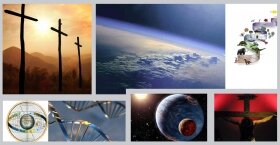
| | Earthrise over the Moon, Apollo 8, NASA. This image helped create awareness of the finiteness of Earth, and the limits of its natural resources. (larger image) Science (from the Latin scientia, 'knowledge') is a system of acquiring knowledge based on the scientific method, as well as the organized body of knowledge gained through such research. Science as defined here is sometimes termed pure science to differentiate it from applied science, which is the application of scientific research to specific human needs. The renewal of learning in Europe, that began with 12th century Scholasticism, came to an end about the time of the Black Death, and the initial period of the subsequent Italian Renaissance is sometimes seen as a lull in scientific activity. The Northern Renaissance, on the other hand, showed a decisive shift in focus from Aristoteleian natural philosophy to chemistry and the biological sciences (botany, anatomy, and medicine). Thus modern science in Europe was resumed in a period of great upheaval: the Protestant Reformation and Catholic Counter-Reformation; the discovery of the Americas by Christopher Columbus; the Fall of Constantinople; but also the re-discovery of Aristotle during the Scholastic period presaged large social and political changes (see the Renaissance). Thus, a suitable environment was created in which it became possible to question scientific doctrine, in much the same way that Martin Luther and John Calvin questioned religious doctrine. The works of Claudius Ptolemaeus (astronomy) and Galen (medicine) were found not always to match everyday observations. Work by Vesalius on human cadavers found problems with the Galenic view of anatomy. | Newton's own copy of his Principia, with handwritten corrections for the second edition (larger image) The willingness to question previously held truths and search for new answers resulted in a period of major scientific advancements, now known as the Scientific Revolution. The Scientific Revolution is traditionally held by most historians to have begun in 1543, when De Revolutionibus, by the astronomer Nicolaus Copernicus, was first printed. The thesis of this book was that the Earth moved around the Sun. The period culminated with the publication of the Philosophiæ Naturalis Principia Mathematica in 1687 by Isaac Newton. Other significant scientific advances were made during this time by - Galileo Galilei,
- Edmond Halley,
- Robert Hooke,
- Christiaan Huygens,
- Tycho Brahe,
- Johannes Kepler,
- Gottfried Leibniz, and
- Blaise Pascal.
In philosophy, major contributions were made by - Francis Bacon,
- Sir Thomas Browne,
- René Descartes, and
- Thomas Hobbes.
The scientific method was also better developed as the modern way of thinking emphasized experimentation and reason over traditional considerations. Approximately 1,000 years ago, modern science began to supplant superstition (the commonly held irrational beliefs emerging from ignorance or fear). What follows is a list of some of the "Founders of Modern Science" who were, with the exception of one, of the Christian faith. The links below provide information regarding each person's faith and contributions to humanity. | - Nicolaus Copernicus
(February 19, 1473 – May 24, 1543) was the astronomer who formulated the first modern heliocentric theory of the solar system. His epochal text, De revolutionibus orbium coelestium (On the Revolutions of the Celestial Spheres, 1543), is often conceived as the starting point of modern astronomy and advanced the heliocentric theory of cosmology, as well as a central and defining epiphany in the history of all science. - John Napier of Merchistoun
(1550 – 4 April 1617) nicknamed Marvellous Merchistoun, was a Scottish mathematician, physicist, astronomer/astrologer and 8th Laird of Merchistoun. He is most remembered as the inventor of logarithms and John Napier's bones, and for popularizing the use of the decimal point. Napier's birth place, Merchiston Tower, Edinburgh, Scotland, is now part of Napier University. He is buried in St Cuthbert's Church, Edinburgh. - Johannes Kepler
(December 27, 1571 – November 15, 1630) was a German Lutheran mathematician, astronomer and astrologer, and a key figure in the 17th century astronomical revolution. He is best known for his laws of planetary motion, based on his works Astronomia nova and Harmonice Mundi; Kepler's laws provided one of the foundations of Isaac Newton's theory of universal gravitation. - Galileo Galilei
(15 February 1564 – 8 January 1642) was an Italian physicist, astronomer, astrologer, and philosopher who is closely associated with the scientific revolution. His achievements include improvements to the telescope, a variety of astronomical observations, including the four largest moons of Jupiter, the phases of Venus, and the rings of Saturn, and made detailed observations of sunspots. He developed the laws for falling bodies based on pioneering quantitative experiments which he analyzed mathematically. According to Stephen Hawking, Galileo probably contributed more to the creation of the modern natural sciences than anybody else. - Francis Bacon, 1st Viscount St Alban, KC
(22 January 1561 – 9 April 1626) was an English philosopher, statesman and essayist but is best known for leading the scientific revolution with his new 'observation and experimentation' theory which is the way science has been conducted ever since. In 1620 he published Novum Organum, which outlined a new system of logic based on the process of reduction, which he offered as an improvement over Aristotle's philosophical process of syllogism. This contributed to the development of what became known as the scientific method.He was knighted in 1603, created Baron Verulam in 1618, and created Viscount St Alban in 1621; without heirs, both peerage titles became extinct upon his death. - Sir Isaac Newton,
(4 January 1643 – 31 March 1727) was an English physicist, mathematician, astronomer, natural philosopher, and alchemist, regarded by many as the greatest figure in the history of science. His treatise Philosophiæ Naturalis Principia Mathematica, published in 1687, described universal gravitation and the three laws of motion, laying the groundwork for classical mechanics. By deriving Kepler's laws of planetary motion from this system, he was the first to show that the motion of objects on Earth and of celestial bodies are governed by the same set of natural laws. The unifying and predictive power of his laws was central to the scientific revolution, the advancement of heliocentrism, and the broader acceptance of the notion that rational investigation can reveal the inner workings of nature. - William Harvey
(April 1, 1578 – June 3, 1657) was an English medical doctor, who is credited with being the first to correctly describe, in exact detail, the properties of blood being pumped around the body by the heart, demonstrating that blood circulates. This developed the ideas of René Descartes who in his Description of the Human Body said that the arteries and veins were pipes which carried nourishment around the body. Although Spanish physician Michael Servetus discovered circulation a quarter century before Harvey was born, all but three copies of his manuscript Christianismi Restitutio were destroyed and as a result, the secrets of circulation were lost until Harvey rediscovered them nearly a century later. Harvey travelled widely in the course of his researches, especially to Italy, where he stayed at the Venerable English College in Rome [ ] . - Blaise Pascal
(June 19, 1623–August 19, 1662) was a French mathematician, physicist, and religious philosopher. He was a child prodigy who was educated by his father. Pascal's earliest work was in the natural and applied sciences where he made important contributions to the construction of mechanical calculators, the study of fluids, and clarified the concepts of pressure and vacuum by generalizing the work of Evangelista Torricelli. Pascal also wrote powerfully in defense of the scientific method. - Robert Boyle
(January 25, 1627 – December 30, 1691) was an Irish natural philosopher, chemist, physicist, inventor, and early gentleman scientist, noted for his work in physics and chemistry. He is best known for the formulation of Boyle's law. Although his research and personal philosophy clearly has its roots in the alchemical tradition, he is largely regarded today as the first modern chemist. He is very famous in the science world for being the first scientist that kept accurate experiment logs. Among his works, The Sceptical Chymist is seen as a cornerstone book in the field of chemistry. - John Wallis
(November 23, 1616 - October 28, 1703) As a mathematician he wrote Arithmetica Infinitorumis, introduced the term Continued fraction, worked on cryptography, helped develop calculus, and is further known for the Wallis product. He also devised a system for teaching the non-speaking deaf. He was also a Calvinist inclined chaplain who was active in theological debate. - Antony van Leeuwenhoek
(October 24, 1632 - August 30, 1723) was a Dutch tradesman and scientist from Delft, Netherlands. He is commonly known as "the Father of Microbiology". Born the son of a basket maker, at age 16 he secured an apprenticeship with a Scottish cloth merchant in Amsterdam. He is best known for his work on the improvement of the microscope and for his contributions towards the establishment of microbiology. Using his handcrafted microscopes he was the first to observe and describe single celled organisms, which he originally referred to as animalcules, and which we now refer to as microorganisms. He was also the first to record microscopic observations of muscle fibers, bacteria, spermatozoa and blood flow in capillaries (small blood vessels). - Carolus Linnaeus
(May 23, 1707 – January 10, 1778) also known after his ennoblement as Carl von Linné (help·info), (May 23, 1707 – January 10, 1778), was a Swedish botanist, physician and zoologist who laid the foundations for the modern scheme of nomenclature. He is known as the "father of modern taxonomy." He is also considered one of the fathers of modern ecology. - Sir Frederick William Herschel, FRS KH
(15 November 1738-25 August 1822) was a German-born British astronomer and composer who became famous for discovering the planet Uranus. He also discovered infrared radiation and made many other discoveries in astronomy. He was born Friedrich Wilhelm Herschel in Hanover, Germany, as one of ten children (of whom four died very young), of Isaac Herschel (1707-1767) a member of the Hanover Military Band. Although Isaac was of Jewish birth, his wife was Christian and the children were raised as Christians. In 1755 the Hanoverian Guards regiment, in whose band William and his brother Jacob were engaged, was ordered to England. At the time, the crowns of England and Hanover were united under George II. He learned English quickly and, at age nineteen, he changed his name to Frederick William Herschel. - Samuel Finley Breese Morse
(April 27, 1791 – April 2, 1872) was an American, a painter of portraits and historic scenes, and co-inventor (with Alfred Vail) of the Morse Code. Samuel Morse was born in Charlestown, Massachusetts, the first child of geographer and pastor Jedidiah Morse and Elizabeth Ann Breese Morse. After attending Phillips Academy, Andover, he went on to Yale. He devoted himself to art and became a pupil of Washington Allston, a well known American painter. While at Harvard University, he attended lectures on electricity from Benjamin Silliman and Jeremiah Day. He earned money by painting portraits. In 1810, he graduated from Yale University. Morse later accompanied Allston to Europe in 1811. - Michael Faraday, FRS
(September 22, 1791 – August 25, 1867) was an English chemist and physicist (or natural philosopher, in the terminology of that time) who contributed significantly to the fields of electromagnetism and electrochemistry. Faraday studied the magnetic field around a conductor carrying a DC electric current, and established the basis for the magnetic field concept in physics. He discovered electromagnetic induction, diamagnetism and electrolysis. He established that magnetism could affect rays of light and that there was an underlying relationship between the two phenomena. - Charles Darwin (12 February 1809 – 19 April 1882)
was already eminent as an English naturalist when he proposed and provided "scientific evidence" to show that all species of life have evolved over time from one or a few common ancestors through the process of natural selection. The theory of evolution became accepted by the scientific community and the general public in his lifetime, while his theory of natural selection came to be widely seen as the primary explanation of the process of evolution in the 1930s, and now forms the basis of modern evolutionary theory. Darwin's theory remains a foundation of biology, but many in the scientific community disbute his claims. - James Prescott Joule, FRS
(December 24, 1818 – October 11, 1889) was an English physicist, born in Sale, near Manchester. Joule studied the nature of heat, and discovered its relationship to mechanical work. This led to the theory of conservation of energy, which led to the development of the first law of thermodynamics. The SI unit of work, the joule, is named after him. He worked with Lord Kelvin to develop the absolute scale of temperature, made observations on magnetostriction, and found the relationship between the flow of current through a resistance and the heat dissipated, now called Joule's law. - William Thomson, 1st Baron Kelvin, (Lord Kelvin) OM, GCVO, PC, PRS, FRSE,
(26 June 1824 – 17 December 1907) was a mathematical physicist, engineer, and outstanding leader in the physical sciences of the 19th century. He did important work in the mathematical analysis of electricity and thermodynamics, and did much to unify the emerging discipline of physics in its modern form. He is widely known for developing the Kelvin scale of absolute temperature measurement. The title Baron Kelvin was given in honour of his achievements, and named after the River Kelvin, which flowed past his university in Glasgow, Scotland. - James Clerk Maxwell
(13 June 1831 – 5 November 1879) was a Scottish mathematician and theoretical physicist. His most significant achievement was formulating a set of equations — eponymically named Maxwell's equations — that for the first time expressed the basic laws of electricity and magnetism in a unified fashion. He also developed the Maxwell distribution, a statistical means to describe aspects of the kinetic theory of gases. These two discoveries helped usher in the era of modern physics, laying the foundation for future work in such fields as special relativity and quantum mechanics. He is also known for creating the first true colour photograph in 1861. - Gregor Johann Mendel
(July 20, 1822 – January 6, 1884) was a German-Czech Augustinian priest and scientist often called the "father of modern genetics" for his study of the inheritance of traits in pea plants. Mendel showed that the inheritance of traits follows particular laws, which were later named after him. The significance of Mendel's work was not recognized until the turn of the 20th century. Its rediscovery prompted the foundation of genetics. - Georg Friedrich Bernhard Riemann
(September 17, 1826 – July 20, 1866) was a German mathematician who made important contributions to analysis and differential geometry, some of them paving the way for the later development of general relativity. Riemann was arguably the most influential mathematician of the middle of the nineteenth century. His published works are a small volume only, but opened up research areas combining analysis with geometry. - Louis Pasteur
(December 27, 1822 – September 28, 1895) was a French chemist best known for his remarkable breakthroughs in microbiology. His experiments confirmed the germ theory of disease, also reducing mortality from puerperal fever (childbed), and he created the first vaccine for rabies. He is best known to the general public for showing how to stop milk and wine from going sour - this process came to be called pasteurization. He is regarded as one of the three main founders of bacteriology, together with Ferdinand Cohn and Robert Koch. He also made many discoveries in the field of chemistry, most notably the asymmetry of crystals. - Joseph Lister, 1st Baron Lister, OM , FRS
(5 April 1827 – 10 February 1912) was an English surgeon who promoted the idea of sterile surgery while working at the Glasgow Royal Infirmary. He successfully introduced carbolic acid (phenol) to sterilize surgical instruments and to clean wounds. Joseph Lister came from a prosperous Quaker home in Upton, Essex, a son of Joseph Jackson Lister, the pioneer of the compound microscope, and Isabella Harris. - George Washington Carver
(July 12, 1864 – January 5, 1943) was an American botanical researcher and agronomy educator who worked in agricultural extension at the Tuskegee Institute in Tuskegee, Alabama, teaching former slaves farming techniques for self-sufficiency. To bring education to farmers, Carver designed a mobile school. It was called a Jesup Wagon after the New York financier, Morris Ketchum Jesup, who provided funding. In 1921, Carver spoke in favor of a peanut tariff before the House Ways and Means Committee. Given racial discrimination of the time, it was unusual for an African-American to be called as an expert. Carver's well-received testimony earned him national attention, and he became an unofficial spokesman for the peanut industry. Carver wrote 44 practical agricultural bulletins for farmers. - Dr. Wernher Magnus Maximilian Freiherr von Braun
(March 23, 1912 – June 16, 1977) was one of the leading figures in the development of rocket technology in Germany and the United States. The German scientist, who led Germany's rocket development program (V-2) before and during World War II, entered the United States at the end of the war through the then-secret Operation Paperclip. He became a naturalized U.S. citizen and worked on the American ICBM (intercontinental ballistic missile) program before joining NASA (National Aeronautics and Space Administration), where he served as director of NASA's Marshall Space Flight Center and the chief architect of the Saturn V launch vehicle, the superbooster that propelled the United States to the Moon. He is generally regarded as the father of the United States space program. Wernher von Braun received the National Medal of Science in 1975. He was tall, articulate and spoke English with a distinctive German accent. - Neil Alden Armstrong
(born August 5, 1930) is a former American astronaut, test pilot, university professor, and naval aviator. He is the first person to have set foot on an extraterrestrial world (the Moon). His first spaceflight was Gemini 8 in 1966, for which he was the command pilot. On this mission, he performed the first manned docking of two spacecraft together with pilot David Scott. Armstrong's second and last spaceflight was as mission commander of the Apollo 11 moon landing mission on July 20, 1969. On this famous "giant leap for mankind", Armstrong and Buzz Aldrin descended to the lunar surface ("The Eagle has landed") and spent 2.5 hours exploring while Michael Collins orbited above. - Francis Collins
He is the director of the US National Human Genome Research Institute. He has also written on religious matters in articles and in Faith and the Human Genome he states the importance to him of "the literal and historical Resurrection of Jesus Christ from the dead, which is the cornerstone of what I believe." He wrote the book The Language of God: A Scientist Presents Evidence for Belief. References - Joseph Agassi (2007) Science and History: A Reassessment of the Historiography of Science (Boston Studies in the Philosophy of Science, 253) Kluwer Academic. ISBN 1-4020-5631-1 (Forthcoming, currently Agassi,J. Towards an Historiography of Science Wesleyan University Press, 1963.
- Thomas S. Kuhn (1996). The Structure of Scientific Revolutions (3rd ed.). University of Chicago Press. ISBN 0-226-45807-5
- Howard Margolis (2002). It Started with Copernicus. New York: McGraw-Hill. ISBN 0-07-138507-X
- Joseph Needham. Science and Civilisation in China. Multiple volumes (1954–2004).
- Bertrand Russell (1945). A History of Western Philosophy: And Its Connection with Political and Social Circumstances from the Earliest Times to the Present Day. New York: Simon and Schuster.
- John L. Heilbron, ed., The Oxford companion to the history of modern science (New York: Oxford University Press, 2003).
- Deepak Kumar (2006). Science and the Raj: A Study of British India, 2nd edition. Oxford University Press. ISBN 0-19-568003-0
- George Rousseau and Roy Porter, eds., The Ferment of Knowledge: Studies in the Historiography of Science (Cambridge: Cambridge University Press, 1980). ISBN 0-521-22599-X
- Caroline L. Herzenberg. 1986. Women Scientists from Antiquity to the Present Locust Hill Press ISBN 0-933951-01-9
| |