theism
Print »     theism
Send »     theism
Add »   Search
Back  
Moble Dictionary of Theology « Mobile » theism

« Main

 Theism
 
Schematic diagram of the human eye
Schematic diagram of the
"irreducibly complex" human eye
(larger image)
1:posterior chamber
2:ora serrata
3:ciliary muscle
4:ciliary zonules
5:canal of Schlemm
6:pupil
7:anterior chamber
8:cornea
9:iris
10:lens cortex
11:lens nucleus
12:ciliary process
13:conjunctiva
14:inferior oblique muscle
15:inferior rectus muscle
16:medial rectus muscle
17:retinal arteries and veins
18:optic disc
19:dura mater
20:central retinal artery
21:central retinal vein
22:optical nerve
23:vorticose vein
24:bulbar sheath
25:macula
26:fovea
27:sclera
28:choroid
29:superior rectus muscle
30:retina
Theism is the belief in one or more deities. More specifically it may also mean the belief that God/god(s) is immanent in the world, yet transcends it.

Theism comes from the Greek word (theos, θεός) meaning God, especially (with G3588) the supreme Divinity, the Godhead, the trinity.

The term "theism" derives from the Greek (θεός Strong's G2316 - theos) meaning God, the supreme Divinity, the Godhead, the trinity. The term theism was first used by Ralph Cudworth (1617–1688).

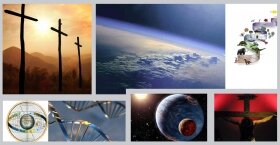
Scientific evidence in support of Theism

  1. the new cosmology
  2. anthropic fine-tuning
    • "A commonsense interpretation of the facts suggests that a superintellect has monkeyed with physics, as well as chemistry and biology, and that there are no blind forces worth speaking about in nature"

      -Fred Hoyle, "the Universe, Past and Present Reflections," Annual Review of Astronomy and Astrophysics 20 (1982)

  3. the origin of life and the origin of information necessary to bring life into existance
    Static thumb frame of
    Animation of the structure
    of a section of DNA.
    • the information for life is stored in DNA and protein molecules
  4. irreducibly complex systems see Irreducible complexity
    • X is too (complex, orderly, adaptive, apparently purposeful, and/or beautiful) to have occurred randomly or accidentally.
    • Therefore, X must have been created by a (sentient, intelligent, wise, and/or purposeful) being. God is that (sentient, intelligent, wise, and/or purposeful) being.
    • Therefore, God exists.
  5. the Cambrian explosion
    • twenty to thirty-five completely novel body plans come online in the Cambrian period.
  6. human consciousness
    • Humans have the capacity for:
      1. self-reflection
      2. representational art
      3. language
      4. creativity

    Lee Strobel, The Case For A Creator, Zondervan, Grand Rapids, Michigan ISBN 0-310-24144-8

The term is attested in English from 1678, and was probably coined to contrast with atheism, a term that is attested from ca. 1587.

Views about the existence of deities are commonly divided into these categories:

  • Nontheism

    The absence of clearly identified belief in any deity
    • atheism: It has two distinct, commonly used meanings:
      • Strong atheism: The belief that no deity exists.
      • Weak atheism: An absence of belief in the existence of deities.
    • agnosticism: The belief that the existence of God or gods is unknown and/or inherently unknowable.
      • Strong agnosticism: The view that the question of the existence of deities is inherently unknowable or meaningless. "It is impossible to say whether or not there is a god"
      • Weak agnosticism: The view that the question of the existence of deities is currently unknown, but not inherently unknowable. "For now, we cannot know. Maybe if we find evidence of god…"
    • Nontheistic religions
  • Deism

    The doctrine that a deity created nature but does not interact with it. This view emphasizes the deity's transcendence.
  • Theism

    (second definition): The doctrine God(s) is immanent in the world, yet transcends it:
    • Polytheism: The belief that there is more than one deity.
      • Monolatry: The belief that there is more than one deity, but only one should be worshipped.
      • Henotheism: The belief that there is more than one deity, but one is supreme.
      • Kathenotheism: The belief that there is more than one deity, but only one deity at a time should be worshipped. Each is supreme in turn.
    • Monotheism: The belief that there is only one deity.
      • Inclusive monotheism: The belief that there is only one deity, and that all other claimed deities are just different names for it.
      • Exclusive monotheism: The belief that there is only one deity, and that all other claimed deities are false and distinct from it, either invented, demonic, or simply incorrect.
  • Panentheism

    The belief that the world is entirely contained within a deity that is greater than just the world.
  • Pantheism

    The belief that the world is identical to a deity.

Within polytheism there are hard and soft varieties. Hard polytheism views the gods as being distinct and separate beings, while soft polytheism views the gods as being subsumed into a greater whole. Most forms of Hinduism serve as examples of soft polytheism.

The Hindu denomination of Smartism serves as an example of inclusive monotheism. Most Abrahamic religions, and the Hindu denomination of Vaishnavism, which regards the worship of anyone other than Vishnu incorrect, serve as examples of exclusive monotheism.

It should be noted that these belief labels are often not as rigid in the literature and in practice as this classification scheme may suggest. For instance, classical Christianity asserts the existence of "lesser" deities such as angels and demons, causing some to argue that the belief system is properly a form of henotheistic polytheism. Most Christians, however, would resist being labeled as polytheists.

Finally, the distinction can be made between belief in the existence of deities, and beliefs about their characteristics, or the belief in a deity as the summum bonum: see eutheism (Omnibenevolence) and dystheism.

Typical theistic religions are Christianity, Judaism, Islam, Zoroastrianism, Saivism, Vaishnavism, Bahá'í, and Sikhism.

References

  • Oxford English Dictionary, Second Edition
  • "Merriam-Webster Online Dictionary". Retrieved on 2009-06-09.
  • See, for example,The Oxford Dictionary of the Christian Church, Second Edition; The Oxford Dictionary of World Religions, 1997, or the current Encyclopedia Britannica.
  • John Orr (English Deism: Its Roots and Its Fruits, 1934) explains that before the seventeenth century theism and deism were interchangeable terms but during the course of the seventeenth century they gained separate and mutually exclusive meanings (see article Deism)
  • Halsey, William; Robert H. Blackburn, Sir Frank Francis (1969). Louis Shores. ed (in English). Collier's Encyclopedia. 22 (20 ed.). Crowell-Collier Educational Corporation. pp. 266–267.
  • AskOxford: monotheism
  • AskOxford: polytheism
  • Philosophical Dictionary: Pacifism-Particular
  • AskOxford: deism
  • Webster's New International Dictionary of the English Language (G. & C. Merriam, 1924) defines deism as "belief in the existence of a personal God, with disbelief in Christian teaching, or with a purely rationalistic interpretation of Scripture".
  • Blue Letter Bible. "Romans 6 - English Standard Version." Blue Letter Bible. 1996-2009. 9 Jun 2009. < http://www.blueletterbible.org/Bible.cfm?b=Rom&c=6&t=ESV >
  • Blue Letter Bible. "Dictionary and Word Search for theos (Strong's 2316)". Blue Letter Bible. 1996-2009. 9 Jun 2009. < http://www.blueletterbible.org/lang/lexicon/lexicon.cfm? Strongs=G2316&t=ESV >
  • Blue Letter Bible. "Dictionary and Word Search for ho (Strong's 3588)". Blue Letter Bible. 1996-2009. 9 Jun 2009. < http://www.blueletterbible.org/lang/lexicon/Lexicon.cfm? Strongs=G3588&t=ESV >

Site this page:

Timothy Ministries Dictionary of Theology. http://timothyministries.org 2005-2010.
"Theism"  < http://timothyministries.org/theologicaldictionary/references.aspx?theword=theism >   Retrieved: Sep 3 2010 9:53PM
#twurch


related to your query 
jihadgo »
Chuck Colsongo »
The Council for Secular Humanismgo »
Islam and anti-semitismgo »
Radical Islamgo »
123
Translate a word/phrase

Translate theism to:
  • العربية/Arabic 
        theism

  • עברית/Hebrew 
        theism

  • فارسی/Persian 
        theism

  • Ελληνικά/Greek 
        theism

  • Afrikaans 
        theism

  • हिन्दी/Hindi 
        theism

  • 日本語/Japanese 
        theism

  • 简体中文/Chinese 
        theism

  • Türk/Turkish 
        theism

  • Русский/Russian 
        theism

  • Polski/Polish 
        theism
Other Items
Torrey's theism
Nave's theism
Easton's theism
Eurekster theism
Add td Search
to your Site.


Short Description
Theism ... more»
Some of the information in this database has been extracted in whole or in part with and without modifications from http://en.wikipedia.org in accordance with their copyleft policy, also known as "Share-alike".

Some of these terms may have been extracted from http://en.wikipedia.org/wiki/ » theism under the terms of the GNU Free Documentation License.

Permission is granted to copy, distribute and/or modify this document under the terms of the GNU Free Documentation License, Version 1.2 or any later version published by the Free Software Foundation; with no Invariant Sections, with no Front-Cover Texts, and with no Back-Cover Texts.

A copy of the license is included in the section entitled "GNU Free Documentation License".
Readers, a word of caution about Wikipedia articles. Wikipedia articles are edited by volunteers. The only necessary qualifications to become a Wikipedia editor are:
  • willingness to contribute and
  • Internet access
and therefore, some Wikipedia articles may not be reliable since an editor could literally be anyone.

For further information about the reliability of Wikipedia articles, see the article: Reliability of Wikipedia

2005-2010 TimothyMinistries.org
Timothy Ministries is an IRS approved non-profit 501(c)(3) organization.
#twurch